Meltwater vs Talkwalker is a comparison between two enterprise monitoring platforms. Both are built for teams that need broad coverage, AI-assisted analysis, dashboards, alerts, and stakeholder reporting. The cleaner choice is about ownership: Meltwater fits PR, communications, media intelligence, and AI visibility work. Talkwalker fits social listening, consumer intelligence, visual monitoring, and Hootsuite-connected social workflows.
The short version:
- Choose Meltwater when PR, communications, reputation, media monitoring, or AI visibility owns the problem.
- Choose Talkwalker when social listening, consumer intelligence, visual/audio monitoring, or Hootsuite workflows are central.
- Choose Syften when you do not need an enterprise intelligence platform and mainly want fast alerts for conversations your team can answer.
That distinction matters because both vendors now talk about social listening, media monitoring, AI, alerts, dashboards, and reports. The buying mistake is assuming overlap means the products are interchangeable. Meltwater is closer to a communications intelligence platform. Talkwalker is closer to a social and consumer intelligence engine.
This guide compares Meltwater and Talkwalker first, then explains when Syften is the better fit for narrower, reply-driven monitoring.
Searching for Talkwalker vs Meltwater? The decision is the same: choose around the team that will own the workflow every week.
Table of contents:
- Meltwater vs Talkwalker at a glance
- The real difference: communications intelligence vs social intelligence
- What the workflow looks like in practice
- Where Meltwater fits best
- Where Talkwalker fits best
- Where Syften fits best
- Data coverage, source claims, and what to verify
- AI features: Mira, GenAI Lens, TalkwalkerAI, and Yeti
- Pricing and contract friction
- Common buying mistakes
- The fastest practical decision
- Meltwater vs Talkwalker: Which should you choose?
- Meltwater vs Talkwalker FAQ
Meltwater vs Talkwalker at a glance
| Meltwater | Talkwalker | Syften | |
|---|---|---|---|
| Core focus | Media intelligence, PR monitoring, social listening, reputation, and AI visibility | Social listening, media monitoring, consumer intelligence, visual/audio monitoring, and Hootsuite-connected workflows | Focused alerts from reply-worthy public conversations |
| Best owner | PR, communications, media intelligence, reputation, and marketing teams | Social intelligence, consumer insights, PR, agencies, and social marketing teams | Founders, marketers, support leads, sales teams, and small B2B teams |
| Best output | Coverage reports, reputation context, crisis alerts, stakeholder dashboards, and AI visibility analysis | Social intelligence reports, visual/audio monitoring, trend analysis, campaign insights, and Hootsuite listening workflows | Actionable alerts routed to Slack, email, RSS, API, Zapier, or webhooks |
| Source coverage | Traditional and digital media: online publications, social, forums, reviews, podcasts, print, TV, radio, and LLMs | Large social and web coverage: 30+ social networks, 150+ million websites, visual content, video, podcasts, and global language coverage | Reddit, Hacker News, GitHub, forums, blogs, X/Twitter, YouTube, podcasts, Slack communities, and more |
| AI positioning | Mira AI, AI-assisted monitoring, reporting, spike detection, sentiment shifts, and GenAI Lens/AI visibility | TalkwalkerAI, AI Agent, LLM Insights, Blue Silk AI, Yeti answers, summaries, and visual listening | AI filtering to decide which keyword matches should trigger an alert |
| Buying path | Contact Sales; tailored quotes by modules, source breadth, scale, users, integrations, onboarding, and contract terms | Request quote; Core, Analyze, and Business packages with custom pricing | Public monthly pricing with a 14-day trial |
| Main risk | Buying a communications platform when the real problem is only narrow mention alerts | Buying an enterprise listening engine without the team capacity to maintain topics and reports | Too narrow when you need formal media intelligence, visual monitoring, or executive reporting |
The real difference: communications intelligence vs social intelligence
Meltwater and Talkwalker overlap on media monitoring, social listening, AI summaries, dashboards, alerts, and reporting. The difference is the job each product is organized around.
Meltwater Media Monitoring starts from communications visibility. Meltwater says its platform connects monitoring, analysis, and reporting so teams can track coverage across channels, measure sentiment and reach, and understand brand position against competitors. It is built around PR, comms, reputation, and stakeholder reporting.
Talkwalker Media Monitoring starts from social and media intelligence at global scale. Talkwalker emphasizes real-time monitoring, sentiment analysis, custom alerts, visual listening, AI summaries, social networks, web sources, video, images, podcasts, and Hootsuite-connected workflows.
The practical difference is this: Meltwater is easier to defend when the weekly work is "what happened to our brand across media, PR, AI answers, and reputation?" Talkwalker is easier to defend when the weekly work is "what are consumers, audiences, and online communities saying across social and visual channels, and what should we do about it?"
What the workflow looks like in practice
The easiest way to choose is to picture the first month after buying the tool.
A Meltwater workflow starts with a communications brief. A PR or media intelligence team tracks brand, executive, product, competitor, campaign, and issue terms across online news, social, forums, reviews, podcasts, print, TV, radio, and AI answers. Alerts catch breaking coverage or sentiment shifts, while dashboards explain reach, share of voice, geography, topic movement, competitors, and message pull-through.
A Talkwalker workflow starts with a social or consumer intelligence brief. A team tracks brand mentions, category conversations, campaign topics, audience sentiment, visual brand appearances, videos, podcasts, and competitors across social networks and web sources. Dashboards and AI summaries help the team find trends, explain spikes, detect risks, and send insight into social, PR, marketing, or BI workflows.
A Syften workflow starts with a conversation worth answering. A founder, marketer, or support lead tracks phrases like "alternative to [competitor]", "[category] recommendation", a product domain, or a problem keyword. When a match appears, it lands in Slack, email, RSS, API, Zapier, or a webhook with a direct link to the thread.

Syften is built around the moment after a relevant match appears: should someone reply now?
When the output you need is a board-ready media intelligence report, Meltwater is closer. When the output is a social intelligence read across audiences, visuals, and trends, Talkwalker is closer. When the output is "open this thread and reply today," Syften is closer.
Where Meltwater fits best
Meltwater fits best when the work is media intelligence, PR monitoring, reputation tracking, and communications reporting.
Meltwater says its media monitoring product tracks a broad range of traditional and digital sources, including over 200 million online publications such as news sites, blogs, review platforms, and forums; more than 20,000 podcasts; global print media; TV and radio broadcasts; and millions of social media sources across platforms like X/Twitter, Facebook, Instagram, Reddit, YouTube, WeChat, and Weibo. Source: Meltwater media monitoring, checked May 14, 2026.
That breadth is useful when a communications team needs one place to understand coverage across formats. A PR team can monitor brand and executive mentions, track competitors, spot emerging issues, measure campaign coverage, report reach and sentiment, and explain how a story moved across channels.
Meltwater is also explicit about AI visibility. Its pricing page lists AI Visibility Tracking as a capability area, and its media monitoring FAQ says GenAI Lens can monitor how brands, products, and competitors are discussed across leading AI assistants and large language models. When leadership asks "how do AI systems describe us?", Meltwater is aligned with that communications problem.
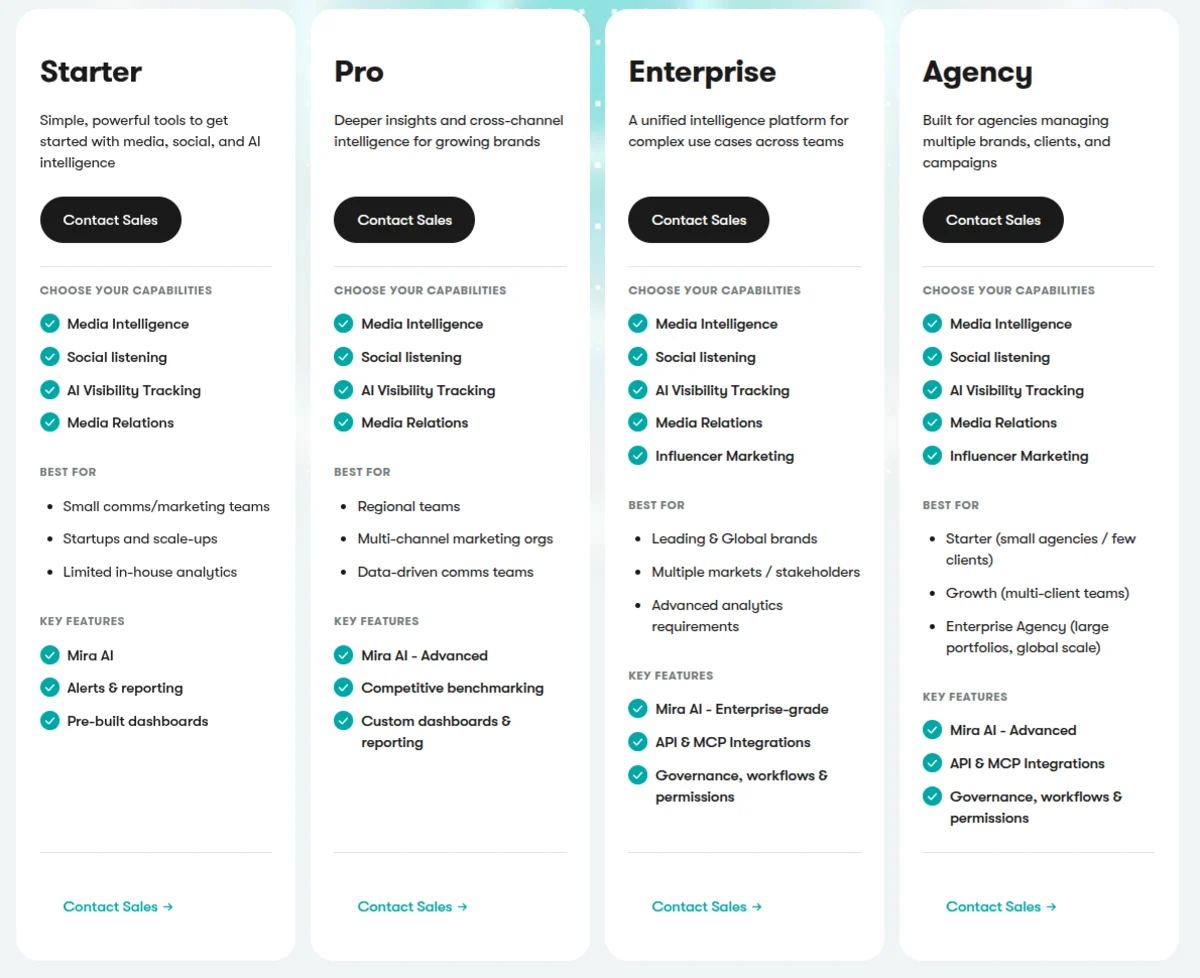
Meltwater packages media intelligence, social listening, AI visibility, media relations, and other capabilities through Contact Sales.
The tradeoff is ownership. Meltwater can cover a lot, but someone still has to design searches, review noisy matches, build dashboards, interpret sentiment, and decide which alerts deserve action. When the real job is only "tell me when someone on Reddit asks for an alternative to our competitor," Meltwater is more platform than that workflow needs.
Where Talkwalker fits best
Talkwalker fits best when the work is social listening, consumer intelligence, visual monitoring, and trend analysis across a large social and web data surface.
Talkwalker says its pricing plans include social listening and media monitoring, topic and channel analytics, custom dashboards, reports, alerts, TalkwalkerAI, AI Agent, LLM Insights, IQ Apps, non-sampled results, and unlimited users. Its public plan names are Core, Analyze, and Business, but buyers still need a custom quote. Source: Talkwalker pricing, checked May 14, 2026.
The clearest Talkwalker edge is social and visual intelligence. Talkwalker says it tracks conversations across 30+ social networks and more than 150 million websites, and its visual and speech recognition page says it can detect brands in images, videos, podcasts, and social audio. Sources: Talkwalker data coverage and Talkwalker visual and speech recognition, checked May 14, 2026.

Visual and audio monitoring are strong reasons to consider Talkwalker when text mentions are not enough.
The Hootsuite connection also matters. Hootsuite says it acquired Talkwalker and that Hootsuite Listening is now powered by Talkwalker. When your social team already lives in Hootsuite, Talkwalker may fit into a broader social media performance workflow instead of standing alone as a separate intelligence platform.
The tradeoff is operational weight. Talkwalker can surface a large amount of signal, but someone has to maintain topics, configure Boolean queries, review dashboards, tune alerts, and turn insight into decisions. Without that owner, the platform can become an impressive dashboard that nobody uses deeply.
Where Syften fits best
Syften fits a different use case: finding conversations worth joining.
A small B2B team might track competitor names, product domains, category terms, founder names, subreddits, forums, GitHub issues, and buying-intent phrases. A good match goes straight to the person who can reply, support the user, learn from the complaint, or start a sales conversation.
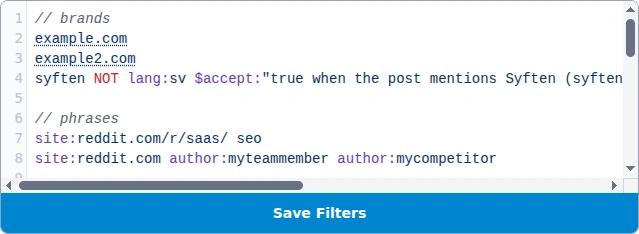
Precise filters matter more than broad source counts when the goal is to receive only alerts someone can act on.
This does not replace Meltwater's media intelligence or Talkwalker's consumer intelligence. Syften is intentionally narrower. It is useful when Reddit, Hacker News, GitHub, forums, Slack communities, YouTube, blogs, and X/Twitter are where people ask questions your team can answer.
The fastest useful Syften setup is deliberately small: track your brand, your closest competitor, your domain, and two or three buying-intent phrases such as "Meltwater alternative", "Talkwalker pricing", or "tool for monitoring Reddit mentions". Send matches to Slack first. Ignore broad mentions, answer specific questions, and tighten the filter when the alert would not change what someone does next.
The tradeoff is reporting depth. Syften will not give you a PR database, broadcast monitoring, AI visibility dashboard, visual recognition, or executive-ready media report. It gives you filtered alerts fast enough to join the conversation.
Data coverage, source claims, and what to verify
Source counts are useful, but they are not the decision by themselves. The useful question is whether the sources, rights, regions, languages, and workflows match the mentions you actually need.
| Question to verify | Meltwater | Talkwalker | Why it matters |
|---|---|---|---|
| Do you need traditional media? | Strong fit: news, print, TV, radio, podcasts, and earned media reporting are core to the media monitoring story. | Also covers online, print, broadcast, social, and more, but the product story leans more social and consumer intelligence. | PR teams usually need coverage context, not just social mentions. |
| Do you need visual or audio recognition? | Useful in broad monitoring, depending on package and use case. | Clear strength: Talkwalker emphasizes image, video, speech, logo, object, scene, and podcast monitoring. | Text-only monitoring misses sponsorships, images, videos, and spoken mentions. |
| Do you need AI visibility? | Clear fit: Meltwater lists AI Visibility Tracking and GenAI Lens as capability areas. | Talkwalker pricing lists LLM Insights to monitor how AI assistants talk about your brand and industry. | AI answer visibility is becoming part of reputation monitoring, but the exact models and workflow matter. |
| Do you need community reply opportunities? | Possible, but broader than a small alert workflow needs. | Possible, but broader than a small alert workflow needs. | When the job is a fast reply, alert quality and routing matter more than total indexed sources. |
Before signing either contract, test your own terms. Use brand names, executive names, competitor names, product domains, subreddit-style phrases, campaign names, and negative issue terms. Check not only whether results exist, but whether the platform makes it obvious what action someone should take next.
AI features: Mira, GenAI Lens, TalkwalkerAI, and Yeti
AI is central to both enterprise platforms, but it reduces different kinds of work.
Meltwater AI is framed around communications awareness and media intelligence. Its social listening page describes AI-assisted spike detection, sentiment shifts, alerts, pattern finding, summaries, dashboards, and reporting. Its media monitoring page describes Mira as a way to ask questions, generate reports, and uncover insights without manually reviewing complex searches.
Talkwalker AI is framed around social and consumer intelligence at scale. Its pricing page lists TalkwalkerAI, AI Agent, LLM Insights, IQ Apps, and AI summaries. Its media monitoring page describes Yeti as an AI assistant that gives plain-language answers about coverage, and its data page says Blue Silk AI processes and summarizes large volumes of data. Sources: Talkwalker pricing and Talkwalker data coverage, checked May 14, 2026.

Talkwalker AI is strongest when the team needs help summarizing, explaining, and acting on large social listening datasets.
Syften AI is narrower. The main workflow is still search, filters, and links to matching conversations. AI filtering helps decide whether a keyword match should trigger a notification. That is a smaller problem, but it is often the problem a small team actually has.
The practical question is not "which platform has AI?" It is "what work do you want AI to reduce?" When the answer is reading and summarizing thousands of media or social mentions, Meltwater or Talkwalker makes sense. When the answer is keeping false positives out of Slack, Syften is the more direct fit.
Pricing and contract friction
Pricing tells you quickly whether the product expects a buyer, a budget owner, or a procurement process.
Meltwater is quote-led. Its pricing page shows Starter, Pro, Enterprise, and Agency packages, but every path routes to Contact Sales. Meltwater says quotes are tailored to goals, modules, program scale, source breadth, monitored regions, data volume, workflows, number of users, integrations, onboarding, support needs, and contract terms. It also says there is no self-serve free trial, though human-guided demos and product tours are available. Source: Meltwater pricing, checked May 14, 2026.
Talkwalker is also quote-led. Its pricing page asks buyers to pick a plan to get a custom quote. Core covers essential always-on social listening and media monitoring; Analyze adds more volume and topics; Business adds the broadest coverage, more historical data, more AI agent questions, more LLM Insights channels, more workspaces, and enterprise governance. Source: Talkwalker pricing, checked May 14, 2026.

Talkwalker publishes plan names and packaging, but buyers still need a custom quote.
Syften publishes monthly pricing: Entry costs $19.95/month, Standard costs $39.95/month, and Pro costs $99.95/month. Standard and Pro include AI filtering, with Pro adding more matches, unlimited archive, API access, and webhooks. Twitter and YouTube monitoring are optional paid add-ons on Standard and Pro.
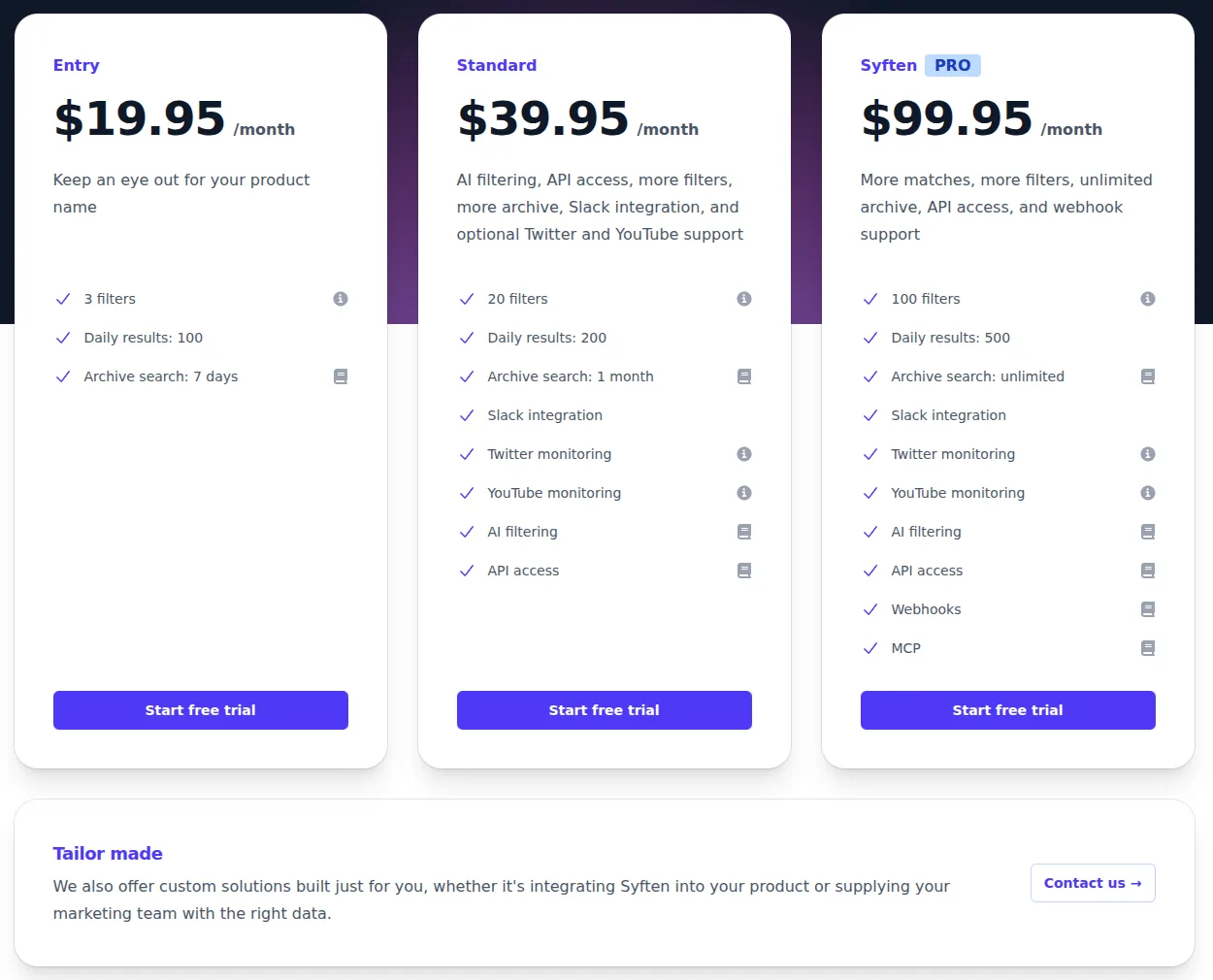
Syften's price reflects the narrower job: useful alerts rather than an enterprise intelligence suite.
Custom pricing is not automatically bad. It often makes sense when the job includes many regions, languages, source rights, users, integrations, governance, onboarding, and services. It is a warning sign only when the problem is much smaller than the purchase process.
Common buying mistakes
Mistake 1: buying on source count instead of workflow. A larger data universe only helps when your team can turn it into decisions, reports, or conversations.
Mistake 2: buying Meltwater when nobody owns communications reporting. Meltwater is strongest when PR, comms, reputation, AI visibility, and media reporting belong together. When those jobs are scattered across teams, the platform may need more coordination than expected.
Mistake 3: buying Talkwalker without analyst or social intelligence capacity. Talkwalker can surface trends, visual mentions, and social signals, but someone still has to maintain topics, read dashboards, and turn insight into action.
Mistake 4: choosing Syften when the brief is truly enterprise. When leadership expects share-of-voice reports, broadcast monitoring, visual recognition, AI visibility dashboards, or multi-market governance, Syften is too narrow. Meltwater or Talkwalker is the right class of product.
The fastest practical decision
Use the weekly work as the tie-breaker.
| Weekly reality | Best fit | Why |
|---|---|---|
| A PR or communications team tracks media coverage, reputation, sentiment, reach, competitors, journalists, AI answers, and stakeholder reports. | Meltwater | The work centers on media intelligence, reporting, issue detection, and communications context. |
| A social intelligence or insights team tracks audience sentiment, visual brand appearances, category trends, campaign movement, and consumer conversations. | Talkwalker | The work centers on social listening, consumer intelligence, visual monitoring, and trend analysis. |
| A founder or small B2B team wants to know when someone asks about an alternative, complains about a competitor, or mentions a category problem. | Syften | The work centers on the alert and the reply. A dashboard is less important than catching the thread while it can still lead to a useful response. |
This is also the easiest way to avoid overbuying. When nobody will maintain media reports, do not buy a communications intelligence platform. When nobody will run social intelligence analysis, do not buy a large listening suite. When nobody will reply to alerts, do not buy Syften either.
Meltwater vs Talkwalker: Which should you choose?
Choose Meltwater when:
- PR, communications, reputation, or media intelligence owns the problem.
- You need monitoring across news, social, print, broadcast, podcasts, forums, reviews, and LLMs.
- Coverage reports, issue detection, reach, sentiment, share of voice, and message pull-through matter.
- AI visibility tracking is part of your communications brief.
- You are comfortable with tailored pricing and a demo-led purchase.
See Meltwater media monitoring
Choose Talkwalker when:
- Social listening, consumer intelligence, or social media performance owns the problem.
- You need visual, image, video, audio, or podcast monitoring alongside text mentions.
- You care about audience trends, campaign insights, social sentiment, and real-time issue detection.
- Your team uses Hootsuite or wants listening connected to Hootsuite workflows.
- You have analyst, social, or agency capacity to maintain topics and interpret reports.
Explore Talkwalker media monitoring
Choose Syften when:
- You want alerts about specific conversations your team can answer quickly.
- Reddit, Hacker News, GitHub, forums, Slack communities, YouTube, or X/Twitter matter to your market.
- You track competitor alternatives, product complaints, support issues, domains, authors, and buying-intent phrases.
- You want matches delivered to Slack, email, RSS, API, Zapier, or webhooks.
- You would rather pay to receive precise alerts than buy an enterprise monitoring suite.
The cleanest decision is not "which product has more features?" It is "which product matches the job we will do every week?"
Pick Meltwater when the week is mostly media monitoring, PR reporting, reputation tracking, AI visibility, and communications intelligence. Pick Talkwalker when the week is mostly social listening, consumer intelligence, trend analysis, visual monitoring, and Hootsuite-connected social workflows. Pick Syften when the week is mostly finding specific public conversations and acting on them while they are still active.
For adjacent comparisons, see Talkwalker vs Brandwatch, Cision vs Meltwater, Brandwatch vs Meltwater, and the Reddit monitoring guide.
Meltwater vs Talkwalker FAQ
Is Meltwater better than Talkwalker?
Meltwater is better when the main job is PR, communications, media intelligence, reputation monitoring, AI visibility tracking, and executive reporting. Talkwalker is better when the main job is social listening, consumer intelligence, visual/audio monitoring, trend analysis, and Hootsuite-connected social workflows.
Is Talkwalker better than Meltwater at social listening?
Often, yes, especially when social listening includes visual recognition, videos, podcasts, audience trends, and Hootsuite workflows. Meltwater also offers social listening, but its center of gravity is broader communications intelligence across earned media, social, forums, reviews, podcasts, broadcast, print, and AI visibility.
Which is better suited to PR teams?
Meltwater is usually the cleaner PR fit when the team needs media monitoring, coverage reports, reputation context, issue detection, and AI visibility in one platform. Talkwalker can also support PR and communications teams, especially when visual monitoring and social intelligence are central to the brief.
Does Meltwater or Talkwalker publish pricing?
Neither publishes simple self-serve list pricing on the main enterprise product. Meltwater shows Starter, Pro, Enterprise, and Agency packages that route to Contact Sales. Talkwalker shows Core, Analyze, and Business packages that require a custom quote.
Does Talkwalker belong to Hootsuite?
Yes. Hootsuite says it acquired Talkwalker, and that Hootsuite Listening is now powered by Talkwalker. Hootsuite says standalone Talkwalker purchases through Talkwalker.com do not include Hootsuite access for now.
Which is better suited to small teams?
When the small team needs formal PR reporting or broad social intelligence, Meltwater or Talkwalker may be worth the sales process. When the small team mainly needs timely alerts from Reddit, Hacker News, GitHub, forums, blogs, YouTube, X/Twitter, and similar sources, Syften is usually the simpler fit.
What is the best alternative to Meltwater or Talkwalker?
Need another media intelligence suite? Compare Brandwatch, Cision, Muck Rack, Sprinklr, or Brand24 depending on the workflow. Need fast alerts from public communities and web conversations your team can answer? Syften is the more focused alternative.
If Reddit is the specific channel you care about, compare dedicated options in our guide to the best Reddit monitoring tools before buying a broad listening suite.
This comparison was fact-checked and refreshed in May 2026 against current pricing and product pages. Pricing, feature packaging, and enterprise contract terms can change, so verify current details with each platform before buying.