Choose Cision when PR outreach, journalist relationships, media releases, and executive reporting need to live in one communications workflow. Choose Meltwater when the core job is media monitoring, social listening, AI-assisted analysis, and global coverage. Choose Syften only when the job is narrower: find live web mentions to review and community conversations your team can answer.
Cision is built around PR operations. CisionOne combines media monitoring, reporting, social listening, journalist outreach, and media release workflows. It makes the most sense when a communications team needs one system for coverage, contacts, pitching, and stakeholder reports.
Meltwater is a media intelligence suite with strong monitoring breadth. It covers online news, social media, print, broadcast, podcasts, forums, blogs, and reviews, then turns that data into dashboards, alerts, reports, and AI-assisted insights. It is usually a better fit when monitoring and analysis matter more than owning a full PR outreach stack.
Both enterprise platforms can be valuable. Both can also be excessive if your team only wants to know when someone mentions you on the public web or asks a question you can answer on Reddit, Hacker News, GitHub, a forum, or X/Twitter.
Syften is the smaller, more direct alternative. It monitors specific keywords across the public web and online communities and sends alerts by email, Slack, RSS, API, or webhook. It will not replace Cision or Meltwater for PR reporting. It can replace the part of the workflow where a small team needs fast, focused alerts instead of a media intelligence dashboard.
For a startup or founder-led team, that distinction matters. A share-of-voice chart is useful. A live thread where someone is asking for a recommendation can be more useful.
Table of contents:
- Cision vs Meltwater at a glance
- The real difference: PR workflow vs media intelligence
- Where Cision fits best
- Where Meltwater fits best
- Where Syften fits best
- Pricing and contract friction
- AI features and their limits
- Integrations and workflow ownership
- Cision vs Meltwater: Which should you choose?
- Cision vs Meltwater FAQ
Cision vs Meltwater at a glance
| Cision | Meltwater | Syften | |
|---|---|---|---|
| Best for | PR and communications teams | Media intelligence and monitoring teams | Startups, founders, and small growth teams |
| Core workflow | Monitor coverage, find journalists, pitch, distribute releases, report results | Monitor media and social coverage, analyze trends, report insights | Monitor keywords and reply to relevant conversations quickly |
| Starting price | Quote required | Quote required | $19.95/month |
| Trial path | Request pricing or demo | Human-guided demo; no self-serve free trial | 14-day trial, no credit card required |
| Media monitoring | Print, online, TV, radio, social, podcasts, magazines | Online news, social, forums, blogs, print, broadcast, podcasts | The public web, communities, forums, blogs, social, podcasts, newsletters, and more |
| Media database | 500k+ validated journalist and media profiles | Media relations and journalist workflows available | Not applicable |
| Web, social, and community monitoring | Social listening and social management inside CisionOne | Major social networks, Reddit, forums, blogs, reviews, podcasts, and news | The public web, Reddit, Hacker News, X/Twitter, GitHub, Stack Exchange, forums, blogs, and more |
| AI capabilities | AI coverage tracking, insights, and pitching features | AI summaries, insights, sentiment, and GenAI Lens/LLM tracking | AI filtering for deciding which matches should alert you |
| Time to value | Best when a PR team can configure and operate the suite | Best when a team can maintain searches, dashboards, and reports | Same day for basic keyword alerts |
| Best alternative use case | Replace scattered PR tools | Centralize monitoring and intelligence | Catch support, sales, competitor, and recommendation threads |
The real difference: PR workflow vs media intelligence
Cision and Meltwater overlap, but the center of gravity is different.
CisionOne is organized around the PR team's day. You can monitor coverage, build reports, find journalists, manage outreach, and handle media release workflows from the same platform. That is useful when the team needs one operating system for communications work.
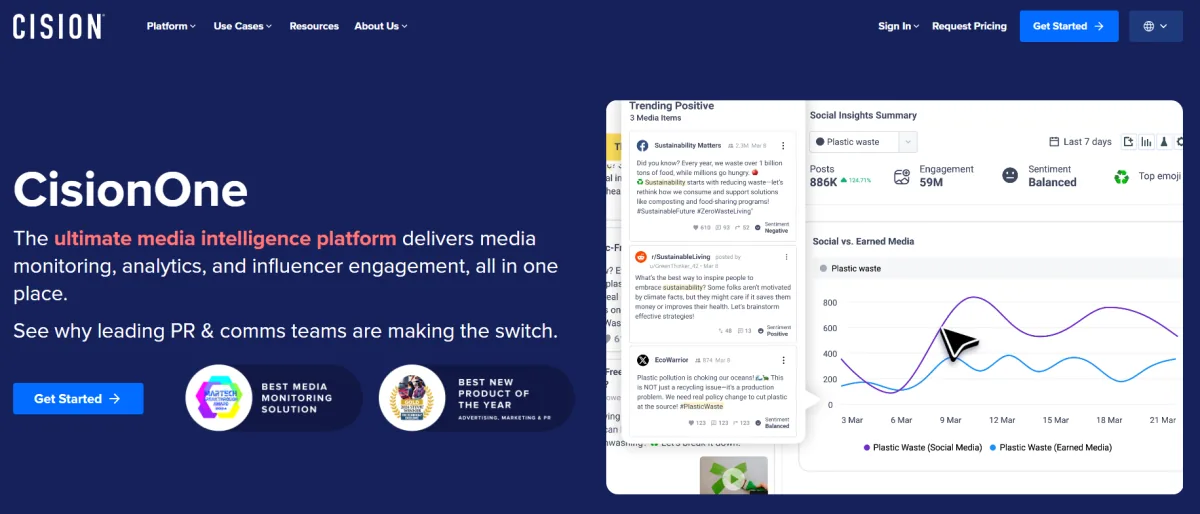
Source: Cision
Meltwater starts more clearly from monitoring and intelligence. It collects coverage from news, social, print, broadcast, podcasts, forums, blogs, and reviews, then helps teams analyze volume, sentiment, share of voice, reach, trends, and competitors. That is useful when the hard part is understanding a large media surface. The sentiment layer is most useful as a way to spot places to investigate, not as an automatic read on reputation.
Source: Meltwater
Syften is not built for media departments. It watches the public web and specific communities, then sends alerts when your filters match. Instead of asking "what is our media picture this quarter?", Syften is built for questions like "did someone mention our category today?" or "did a competitor just come up in a thread we should answer?"

Source: Syften
Where Cision fits best
Cision fits best when media intelligence and PR execution are part of the same job.
Cision's clearest edge is the outreach layer. Cision says its journalist outreach product includes more than 500,000 media profiles across 225 countries and territories, curated by an in-house research team. For PR teams that pitch journalists every week, contact quality, beat context, and outreach history matter as much as monitoring coverage.
CisionOne also covers real-time media monitoring across print, online, TV, radio, social, podcasts, and magazines. Monitoring feeds reporting; reporting informs outreach; outreach can connect back to media release and measurement workflows. That closed loop is the point.
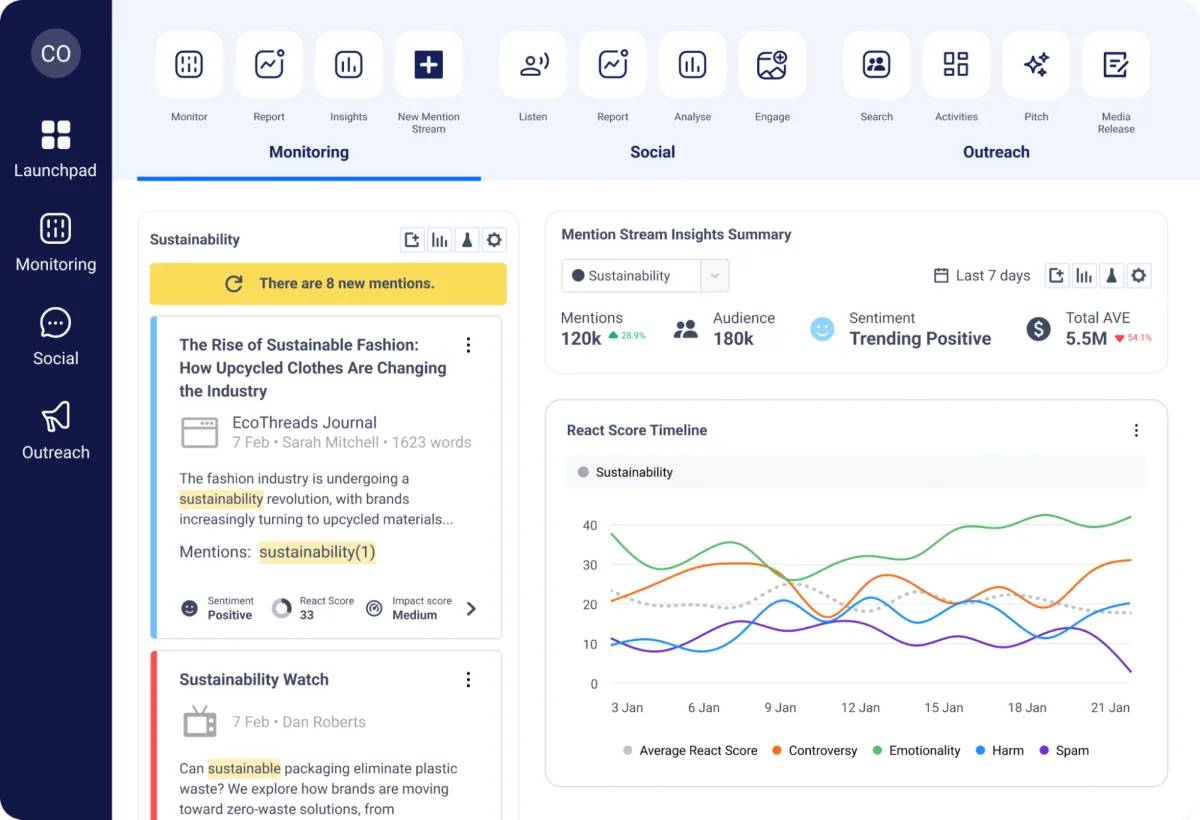
Source: Cision
The tradeoff is buying process and operational weight. Cision does not publish a simple price list. Its pricing page routes buyers into packages such as Journalist Outreach, Media Monitoring, Media Monitoring + Social, and the broader CisionOne Suite. That is normal for enterprise PR software, but it slows down teams that only wanted a quick monitoring setup.
Choose Cision when PR workflow ownership matters. If your team does not pitch journalists, build media lists, distribute releases, or create formal comms reports, Cision is more platform than you need.
Where Meltwater fits best
Meltwater fits best when the main job is monitoring breadth and analysis across many source types.
Meltwater says it captures content from more than 270,000 global news sources, plus social media platforms, forums, blogs, print publications, broadcasts, and podcasts. Its media monitoring product is designed for teams that want one place to track mentions, benchmark competitors, spot trends, and report coverage.
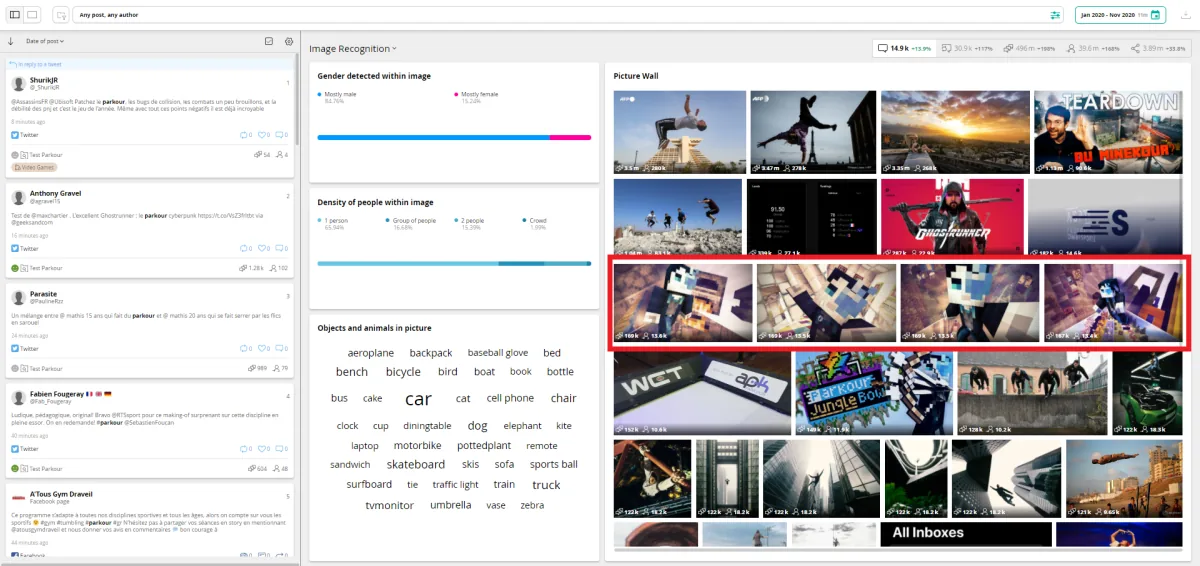
Source: Meltwater
Social listening is also a first-class part of the product. Meltwater's source list includes Facebook, Instagram, X, YouTube, Reddit, LinkedIn, Twitch, Pinterest, blogs, discussion forums, podcasts, online news, and consumer review sites. That breadth is useful when a comms team needs a 360-degree view rather than a single community alert.
The tradeoff is that broad monitoring still needs query design, filters, reports, and ownership. Large source coverage is only useful when someone keeps searches clean and dashboards relevant. Without that owner, Meltwater can collect data faster than the team can turn it into decisions.
Choose Meltwater when monitoring, analytics, and stakeholder reporting are the work. If your real need is "send me a Slack alert when someone asks for an alternative to my competitor," Meltwater is a large answer to a small problem.
Where Syften fits best
Syften fits best when the outcome is a reply, not a report.
A startup might monitor phrases like "alternative to [competitor]", "[category] recommendation", "[competitor] too expensive", or its own domain. When a match appears, Syften sends it to Slack, email, RSS, API, Zapier, or a webhook so the right person can decide whether to join the conversation.

The sources reflect that job. Syften monitors the public web, Reddit, Hacker News, Stack Exchange, GitHub, blogs, forums, newsletters, podcasts, Slack communities, Bluesky, Mastodon, YouTube, X/Twitter, and more. The goal is not to measure every public impression. The goal is to find the few mentions and conversations that are worth acting on.
The filtering model matters. A precise alert for site:reddit.com/r/saas/ "alternative to" hubspot is more useful to a founder than a broad dashboard full of weak mentions. Syften also supports AI filtering when keyword matching alone is too blunt.
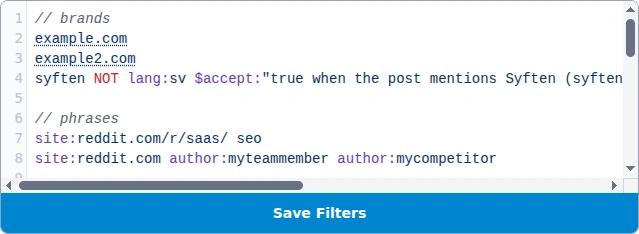
The limitation is equally clear: Syften is not a PR database, a press release tool, or a broad media intelligence platform. It is a focused alerting workflow for web monitoring, community monitoring, lead discovery, competitor monitoring, customer support, and founder-led marketing.
Pricing and contract friction
Pricing tells you whether the vendor expects a quick buyer or a procurement process.
Cision does not publish a self-serve price list for CisionOne. Its pricing page asks buyers to choose a package and request pricing:
- No listed public price
- Packages include Journalist Outreach, Media Monitoring, Media Monitoring + Social, and CisionOne Suite
- Quote depends on the products, scope, users, and services you need
- Best buying path: request pricing for the specific PR workflow you plan to operate
Meltwater follows a similar custom model. Its pricing page says quotes are tailored to goals, modules, source breadth, data volume, users, integrations, onboarding, support needs, and contract terms:
- No listed public price
- Plans are customized by modules, regions, languages, users, integrations, and support
- No self-serve free trial; human-guided demos and product tours are available
- Most partnerships are structured as annual agreements, with a typical 12-month minimum
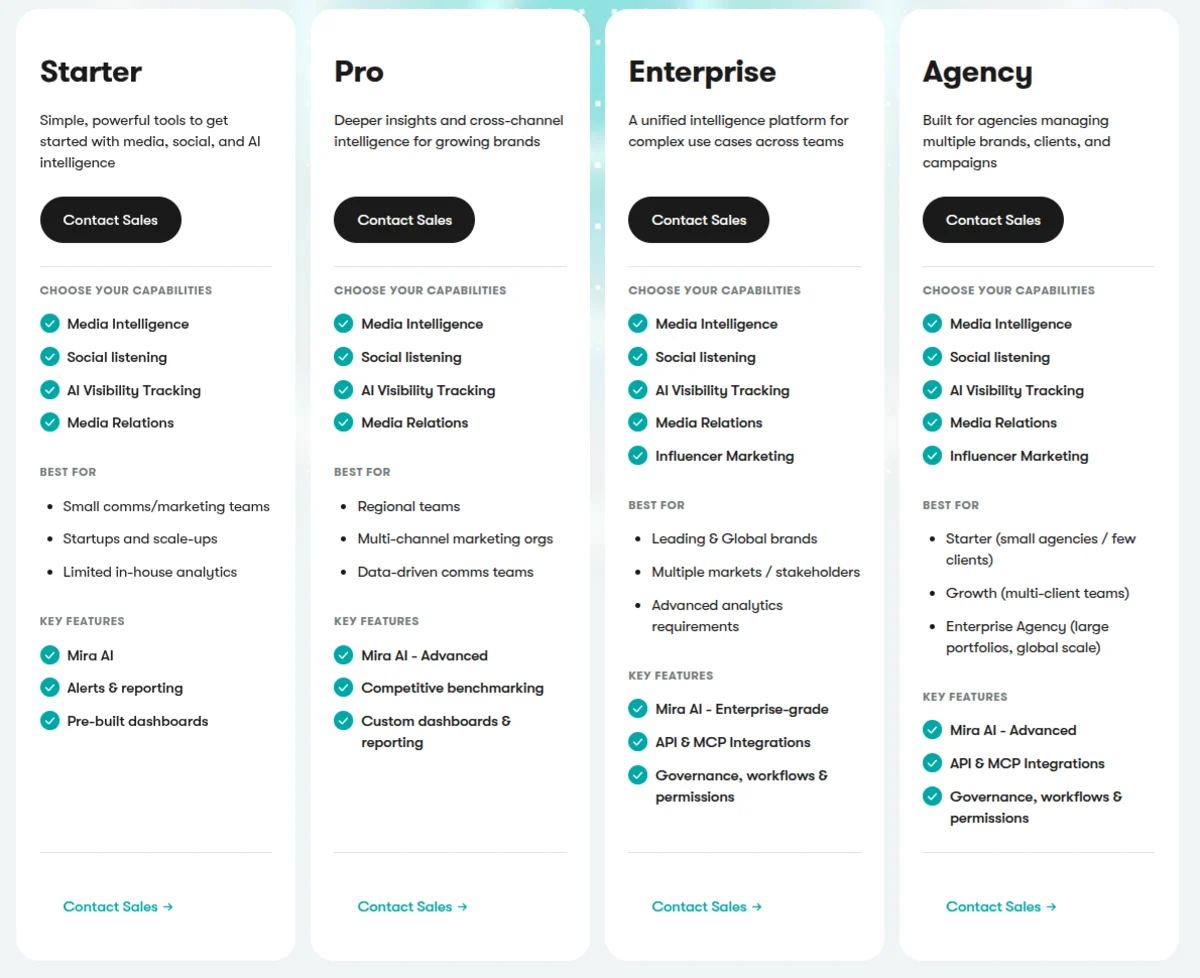
Meltwater shows plan tiers, but the buying path still runs through Contact Sales and tailored contracts.
Syften publishes monthly pricing:
- Entry: $19.95/month
- Standard: $39.95/month, with AI filtering, Slack integration, and optional Twitter and YouTube support
- Pro: $99.95/month, with more matches, unlimited archive, API access, webhooks, and optional Twitter and YouTube support
- Free trial: 14 days, no credit card required
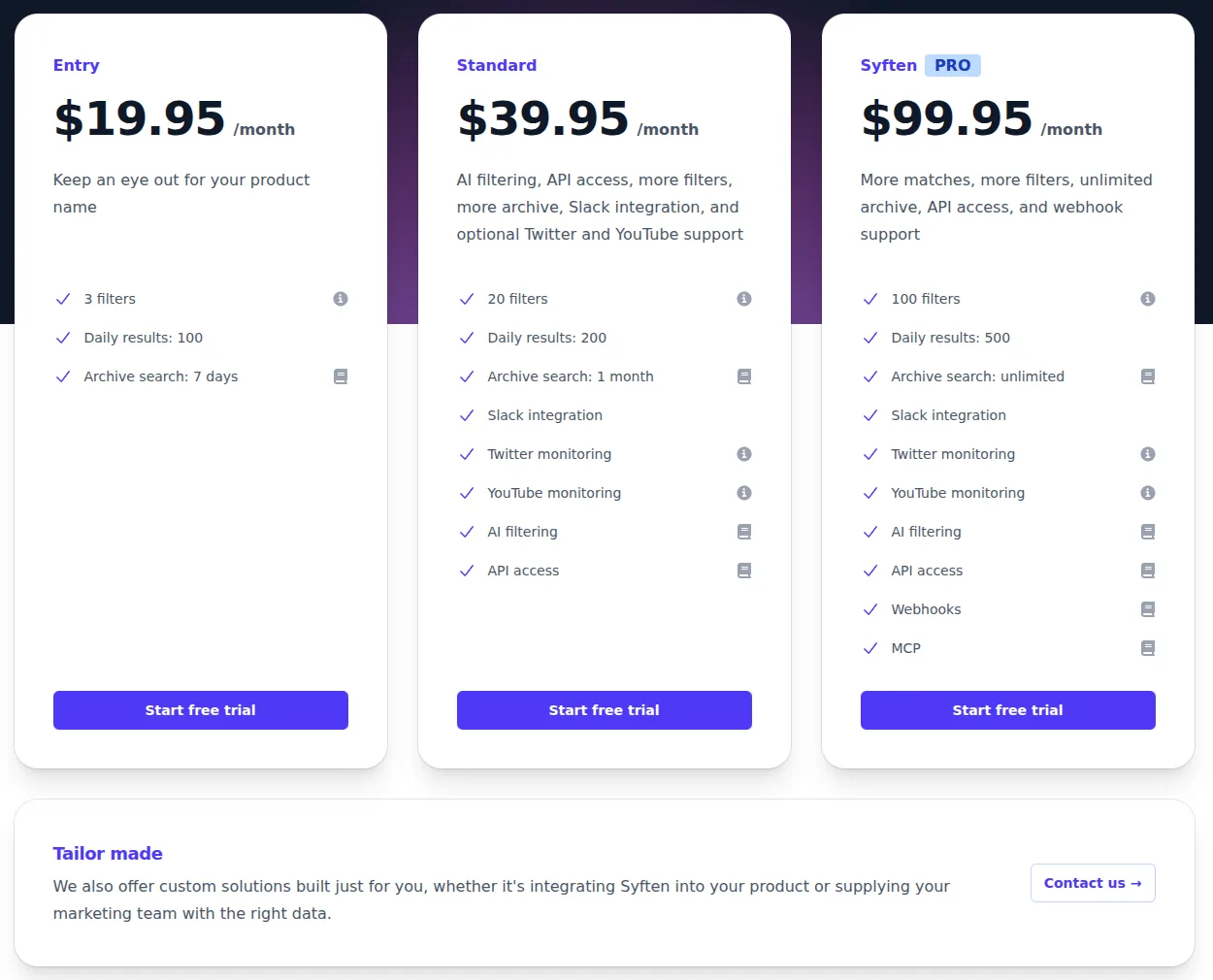
That does not make Syften "cheaper Cision" or "cheaper Meltwater." It makes Syften easier to buy when the problem is narrower than enterprise media intelligence.
AI features and their limits
AI is useful in all three products, but it is not solving the same problem.
Cision uses AI around media coverage, insights, and pitching. That is useful when a PR team is trying to understand coverage and turn it into outreach or reporting work.
Meltwater uses AI for media monitoring, summaries, sentiment, trend analysis, reporting, and GenAI Lens/LLM visibility tracking. This is most useful when the dataset is too large for a person to read manually.
Syften keeps AI closer to the alert decision. The main workflow is still search, filters, and links to matching conversations. AI filtering helps decide whether a keyword match deserves a notification.
The practical question is not "which platform has AI?" It is "what work do you want AI to reduce?" If the answer is reading thousands of media mentions, Cision or Meltwater makes more sense. If the answer is rejecting false positives before they hit Slack, Syften is the more direct fit.
Integrations and workflow ownership
Integrations matter most after launch, when monitoring has to become part of daily work.
Cision wants to be the PR team's system of record. That makes sense when media lists, outreach, release workflows, coverage, and reports all need to live close together.
Meltwater wants to be the media intelligence layer. Its reporting, dashboards, exports, and BI/API paths matter when coverage data has to feed a larger communications or analytics process.
Syften assumes it is part of your stack, not the center of it. Slack, email, RSS, Zapier, API access, and webhooks are enough for most small teams because the alert itself is the handoff.
Cision vs Meltwater: Which should you choose?
The cleanest choice starts with the team that owns the work.
Choose Cision if:
- PR and communications own the workflow
- You need journalist outreach and media contact data
- Media releases and PR measurement are regular work
- You want monitoring, outreach, and reporting in one platform
- You have budget and time for a negotiated enterprise setup
Explore CisionOne for PR and communications teams
Choose Meltwater if:
- Media monitoring and intelligence are the central problem
- You need broad coverage across news, social, print, broadcast, podcasts, forums, and blogs
- AI summaries, sentiment, share of voice, and dashboards help your stakeholders
- You can maintain searches, dashboards, and reports over time
- You are comfortable with tailored pricing and annual contracts
See Meltwater's media monitoring product
Choose Syften if:
- You need specific alerts, not broad media analytics
- The public web, Reddit, Hacker News, GitHub, forums, or X/Twitter matter to your market
- You want to reply to relevant threads while they are still active
- Your budget is closer to $20-$100/month than an enterprise contract
- You want to be productive immediately instead of training on a suite
Start Syften's 14-day free trial
Cision and Meltwater are large choices. They make sense when your team has a large, recurring communications or media intelligence job.
If your actual need is narrower, do not buy the whole suite by default. A small team that wants to catch questions, complaints, competitor mentions, and recommendation threads may get more value from Syften than from another analytics dashboard.
For adjacent comparisons, see Hootsuite vs Brandwatch, Brandwatch vs Meltwater, and the Reddit monitoring guide.
Cision vs Meltwater FAQ
Is Cision better than Meltwater?
Cision is better when PR outreach, journalist relationships, media releases, and formal communications workflows are central. Meltwater is better when the main job is broad media monitoring, social listening, AI-assisted analysis, and reporting.
Is Meltwater cheaper than Cision?
Neither vendor publishes a simple public price list for the full platform, so you need a quote to compare actual cost. Meltwater says pricing is tailored to modules, source breadth, data volume, users, integrations, onboarding, support, and contract terms. Cision routes buyers through package-specific pricing requests.
Do Cision and Meltwater offer free trials?
Cision's public buying path is demo and pricing request led. Meltwater says it does not offer a self-serve free trial, but it does offer human-guided demos and product tours. Syften offers a 14-day free trial without a credit card.
Which is better for PR outreach?
Cision is the stronger default for PR outreach because journalist data, pitching, media release workflows, and PR reporting are central to CisionOne. Meltwater has media relations capabilities too, but its comparison strength is broader monitoring and intelligence.
Which is better for social listening?
Meltwater is the stronger fit when social listening is part of a broad media intelligence program. Cision also includes social listening and management inside CisionOne. Syften is stronger when you care less about dashboards and more about direct alerts from specific communities.
Can you trust sentiment analysis in Cision or Meltwater?
Buyers should treat sentiment analysis in Cision, Meltwater, or any media intelligence tool as a signal for investigation, not as an automatic read on reputation. Media coverage often mixes several targets in one article: the company, competitors, executives, market conditions, analyst quotes, and customer reactions. A single sentiment label can attach the tone to the wrong thing. Ask how the tool decides what entity the sentiment is about, and review examples before using the chart in stakeholder reports. For the full caveat, read why sentiment analysis can be misleading.
What is a simpler alternative to Cision and Meltwater?
If you need PR databases, press release workflows, or broad media intelligence, Cision and Meltwater are better fits. If you need fast keyword alerts from the public web and communities like Reddit, Hacker News, GitHub, forums, blogs, and X/Twitter, Syften is a simpler alternative.
If Reddit is the specific channel you care about, compare dedicated options in our guide to the best Reddit monitoring tools before buying a broad listening suite.
This comparison was fact-checked and refreshed in May 2026 against current pricing and product pages. Pricing, feature packaging, and enterprise contract terms can change, so verify current details with each platform before buying.