Brandwatch is the better fit for social and consumer intelligence research. Meltwater is the better fit for media intelligence, PR monitoring, and AI visibility work. Syften belongs in the comparison when the job is narrower: find live community conversations your team can answer.
Brandwatch is strongest when the owner is an insights, research, or social intelligence team. Its strength is turning large social and consumer datasets into audience analysis, trend reports, dashboards, and AI-assisted insights.
Meltwater is strongest when the owner is a PR, communications, or media intelligence team. It combines media monitoring, social listening, journalist workflows, reporting, and newer AI visibility tracking into a broader communications suite.
Both products can be valuable. Both can also be too much if your team only needs to know when a prospect asks a question in a community you care about.
Syften is the smaller, more direct alternative. It does not replace a consumer intelligence or media intelligence department. It watches specific communities and sends alerts fast enough that you can still join the conversation.
For a startup, that distinction matters. A dashboard about the market is useful. A live thread where someone is asking for help can be more useful.
Table of contents:
- Brandwatch vs Meltwater at a glance
- The real difference: consumer intelligence vs media intelligence
- What the workflow looks like in practice
- Where Brandwatch fits best
- Where Meltwater fits best
- Where Syften fits best
- AI features: Iris AI, Meltwater AI, and Syften filtering
- Pricing and contract friction
- Integrations and workflow ownership
- Common buying mistakes
- Brandwatch vs Meltwater: Which should you choose?
- Brandwatch vs Meltwater FAQ
Brandwatch vs Meltwater at a glance
| Brandwatch | Meltwater | Syften | |
|---|---|---|---|
| Primary strength | Consumer intelligence and social analytics | Media intelligence, PR monitoring, and AI visibility | Real-time community keyword alerts |
| Starting price | Quote required | Quote required | $19.95/month |
| Data sources | 100 million+ sources, 1.7 trillion historical conversations, 501 million new conversations/day | 270,000+ news sources, 500 million+ new content pieces/day, plus social, print, broadcast, podcasts, forums, blogs, and LLMs | Reddit, Hacker News, GitHub, X/Twitter, forums, blogs, Slack communities, and more |
| Best owner | Insights, research, social intelligence, and social teams | PR, communications, media intelligence, and reputation teams | Founders, growth, support, sales, and small agencies |
| AI capabilities | Iris AI for query writing, Ask Iris, summaries, insights, writing, and post analysis | GenAI Lens, Mira Companion, Discovery AI Assistant, and Radarly generative analysis | AI filtering for deciding which keyword matches should alert you |
| Pricing motion | Demo-led, quote required | Demo-led, tailored quote, no self-serve free trial | Public monthly pricing, 14-day free trial |
| Best output | Research, dashboards, audience insights, social intelligence reports | Media reports, PR alerts, reputation tracking, AI visibility context | Actionable alerts that route to email, Slack, RSS, API, or webhooks |
| Best for | Enterprises and agencies that analyze consumer conversations at scale | Communications teams that monitor coverage across many media formats | Small teams that need to find and answer specific conversations |
The real difference: consumer intelligence vs media intelligence
Brandwatch and Meltwater overlap on social listening, dashboards, alerts, and reporting. The difference is the center of gravity.
Brandwatch Consumer Intelligence is built around understanding people, audiences, topics, competitors, and market shifts from large social and web datasets. The question is usually analytical: what is changing, who is talking, what do they care about, and what should the business do next?
Meltwater Media Monitoring is built around communications visibility. It tracks earned, owned, and social conversations across news, social, print, broadcast, podcasts, forums, blogs, and LLMs so PR and communications teams can understand coverage, risks, reach, and reputation.
Syften starts from a different job. It does not try to become your research suite or PR command center. It watches the places where useful web mentions and public conversations happen and alerts you when your filters match.
What the workflow looks like in practice
The easiest way to choose is to picture the first month after buying the tool.
A Brandwatch workflow starts with a research question. An analyst builds a query around a market, competitor, campaign, or audience segment, removes irrelevant matches, checks spikes, uses dashboards and AI summaries to find patterns, then turns the result into a brief for marketing, product, or leadership. The value is not the alert itself. The value is the interpreted insight.
A Meltwater workflow starts with a communications risk or reporting need. A PR team tracks company, executive, product, competitor, and campaign terms across news, social, print, broadcast, podcasts, forums, blogs, and AI answers. Alerts route breaking coverage to the right people, while dashboards and reports explain reach, sentiment, share of voice, and reputation changes. The value is knowing what the media picture looks like and what needs attention. The caveat is that sentiment becomes less trustworthy as soon as a story mentions the company, a competitor, and the market in the same article.
A Syften workflow starts with a reply opportunity. A founder, marketer, or support lead tracks phrases like "alternative to [competitor]", "[category] recommendation", or a product domain. When a match appears, it lands in Slack or email with a link to the thread. The value is not a quarterly report. The value is catching a conversation while it is still active.
Where Brandwatch fits best
Brandwatch fits best when the work is consumer intelligence, audience research, social analytics, and ongoing insight production.
Brandwatch says its consumer intelligence product gives access to more than 100 million online sources, 1.7 trillion historical conversations back to 2010, and 501 million new conversations every day. It also emphasizes official firehose access to X/Twitter, Tumblr, and Reddit. That scale matters when an analyst needs to compare audiences, markets, competitors, and long-term trends.

Source: Brandwatch
Its strengths are research-oriented: query building, audience segmentation, dashboards, alerts, image analysis, custom classifiers, AI summaries, and reporting. Those are useful when the output is a market insight, campaign decision, audience brief, or board-ready research note.

Source: Brandwatch
The tradeoff is operational weight. Brandwatch makes the most sense when someone will own query quality, dashboards, interpretation, and stakeholder reporting. If no one owns that work, a powerful research platform can become a place where interesting data accumulates without changing decisions.
The buyer objection to take seriously is time. Brandwatch can answer sophisticated questions, but sophisticated questions require setup, taxonomy decisions, exclusions, saved views, and someone who knows when the data is misleading. A vague query for a broad category can produce a beautiful dashboard that still does not tell the team what to do.
Where Meltwater fits best
Meltwater fits best when the work is media intelligence, PR monitoring, reputation tracking, and communications reporting.
Meltwater says its media monitoring product scans more than 270,000 global news sources, brings in more than 500 million pieces of new content every day, and covers social media, forums, blogs, print publications, broadcasts, podcasts, and LLMs. It also describes real-time alerts, dashboards, sentiment, reach, share of voice, geographic views, and exports for BI tools.

Source: Meltwater
That breadth is useful when the communications team needs one place to see coverage across formats and report what happened. A PR team can use Meltwater to monitor brand mentions, track competitors, catch reputation issues, measure coverage, and connect findings to media lists or reporting workflows.
Meltwater has also moved into AI visibility. Its GenAI Lens product tracks how major AI systems describe brands, competitors, and topics, including the sources those systems cite. That makes Meltwater more relevant for teams that now treat AI answers as part of reputation and communications monitoring.
The tradeoff is that broad media intelligence needs ownership. Someone still has to design searches, clean noisy results, build reports, and decide which signals matter. If the team only needs a handful of community alerts, Meltwater is a large answer to a small problem.
The buyer objection to take seriously is bundle fit. Meltwater is easier to justify when media monitoring, PR reporting, reputation tracking, and AI visibility all belong to the same team. If those jobs are split across PR, social, SEO, and product marketing, the platform may need more coordination than the original problem suggested.
Where Syften fits best
Syften fits best when the outcome is a reply, not a report.
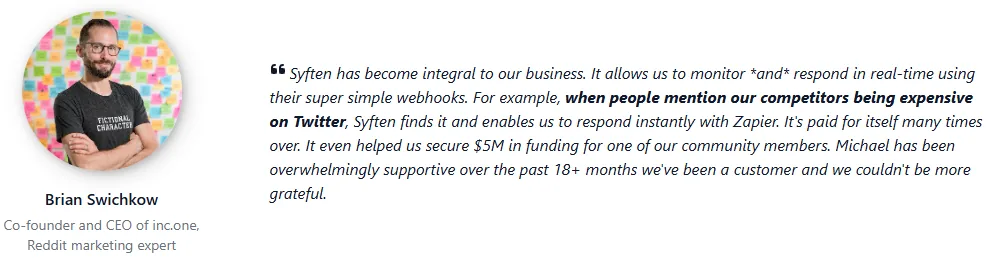
A startup might monitor phrases like "alternative to [competitor]", "[category] recommendation", "[competitor] too expensive", or its own domain. When a match appears, Syften sends it to Slack, email, RSS, API, Zapier, or a webhook so the right person can decide whether to join the conversation.
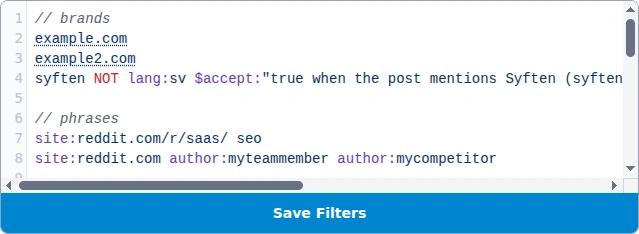
Source: Syften
This is a narrower product by design. Syften does not offer a consumer research archive, PR database, media monitoring suite, or executive reporting platform. It focuses on alert quality, source coverage for community conversations, and delivery into the tools where small teams already work.
For B2B and technical audiences, sources like Reddit, Hacker News, Stack Overflow, GitHub, and specialized forums can be more actionable than a broad media firehose. The volume is lower, but the intent is often clearer.
AI features: Iris AI, Meltwater AI, and Syften filtering
AI is now central to both enterprise platforms, but the jobs are different.
Brandwatch Iris AI is aimed at research and social workflows. Brandwatch describes Ask Iris for conversational exploration, quick search, query writing with keyword, hashtag, and subreddit recommendations, summaries of trends and anomalies, content assistance, reply generation, and competitor post analysis.

Source: Brandwatch
Meltwater AI is aimed at communications awareness and media intelligence. Meltwater describes GenAI Lens for AI visibility tracking, Mira Companion for help inside Meltwater, Discovery AI Assistant for unusual changes in datasets, and Radarly generative features for contextual explanations and analysis cards.

Source: Meltwater
Syften uses AI more narrowly. The main workflow is still search, filters, and direct links to matching conversations. AI filtering helps decide which matches should trigger alerts when keyword matching alone is too broad.
Pricing and contract friction
Pricing tells you quickly whether the product expects a buyer, a budget owner, or a procurement process.
Brandwatch is demo-led. Its plans page groups products into Consumer Intelligence, Social Media Management, Influencer Marketing, Search Intelligence, and related suite options, but it does not publish a simple starting price for buyers to compare.
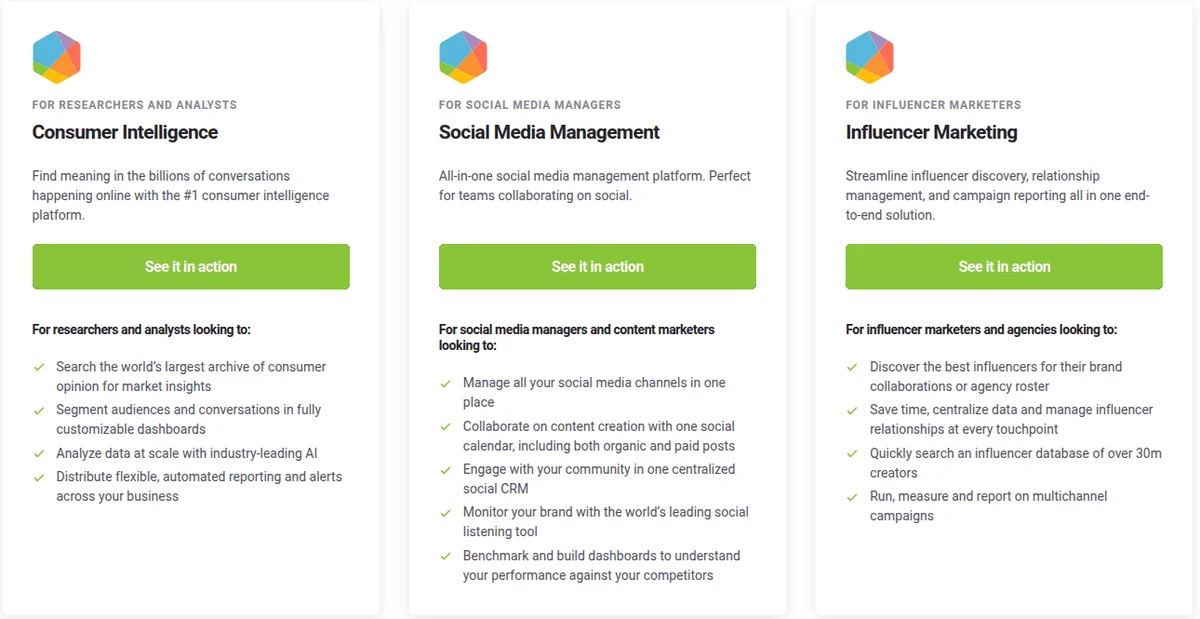
Source: Brandwatch
Meltwater is also quote-led. Its pricing page says quotes are tailored to goals, modules, source breadth, data volume, users, integrations, onboarding, support needs, and contract terms. Meltwater also says it does not offer a self-serve free trial, but does offer human-guided demos and product tours.
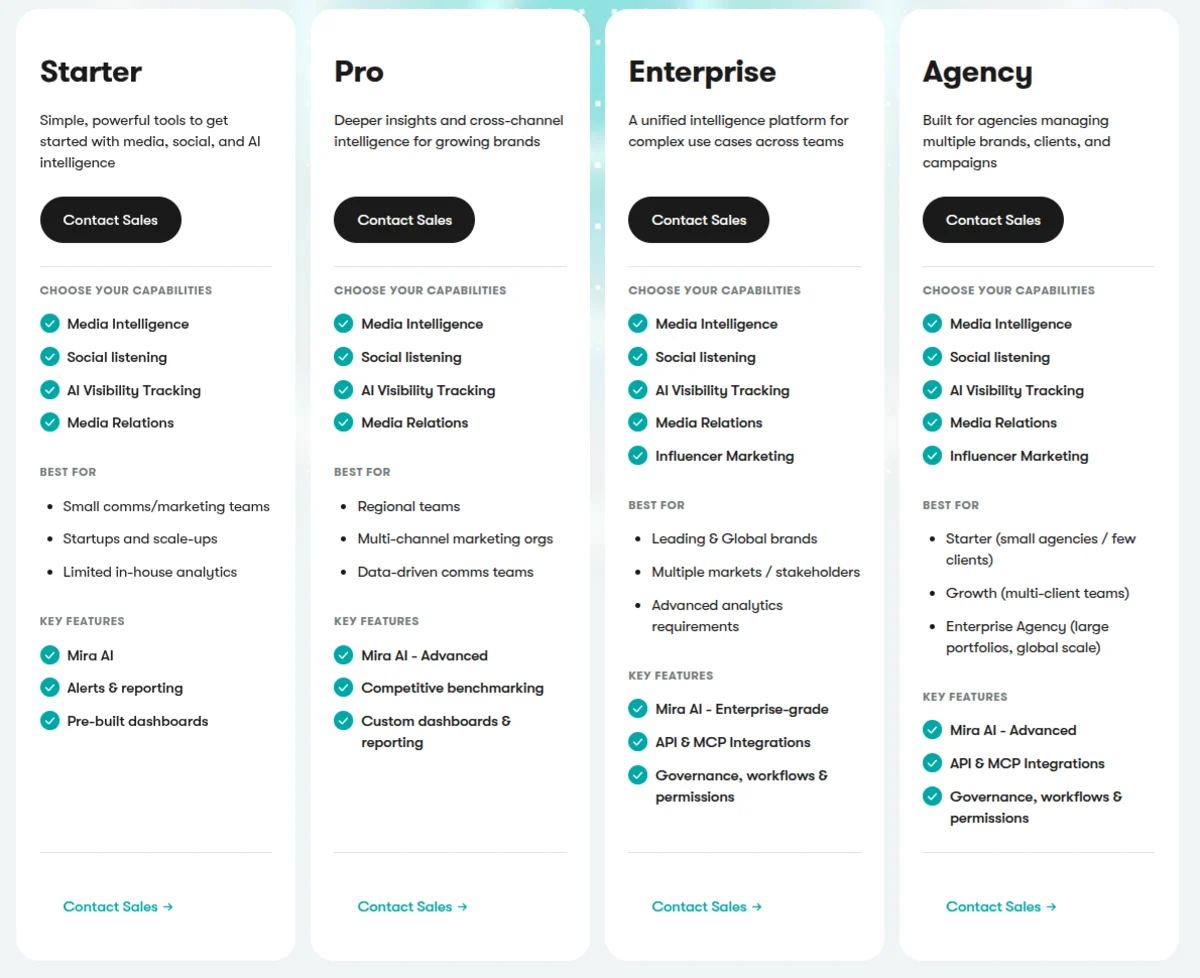
Source: Meltwater
Syften publishes three tiers at $19.95, $39.95, and $99.95 per month. Standard and Pro include AI filtering, with Pro adding more matches, unlimited archive, API access, and webhooks. Twitter and YouTube monitoring are optional paid add-ons on Standard and Pro.
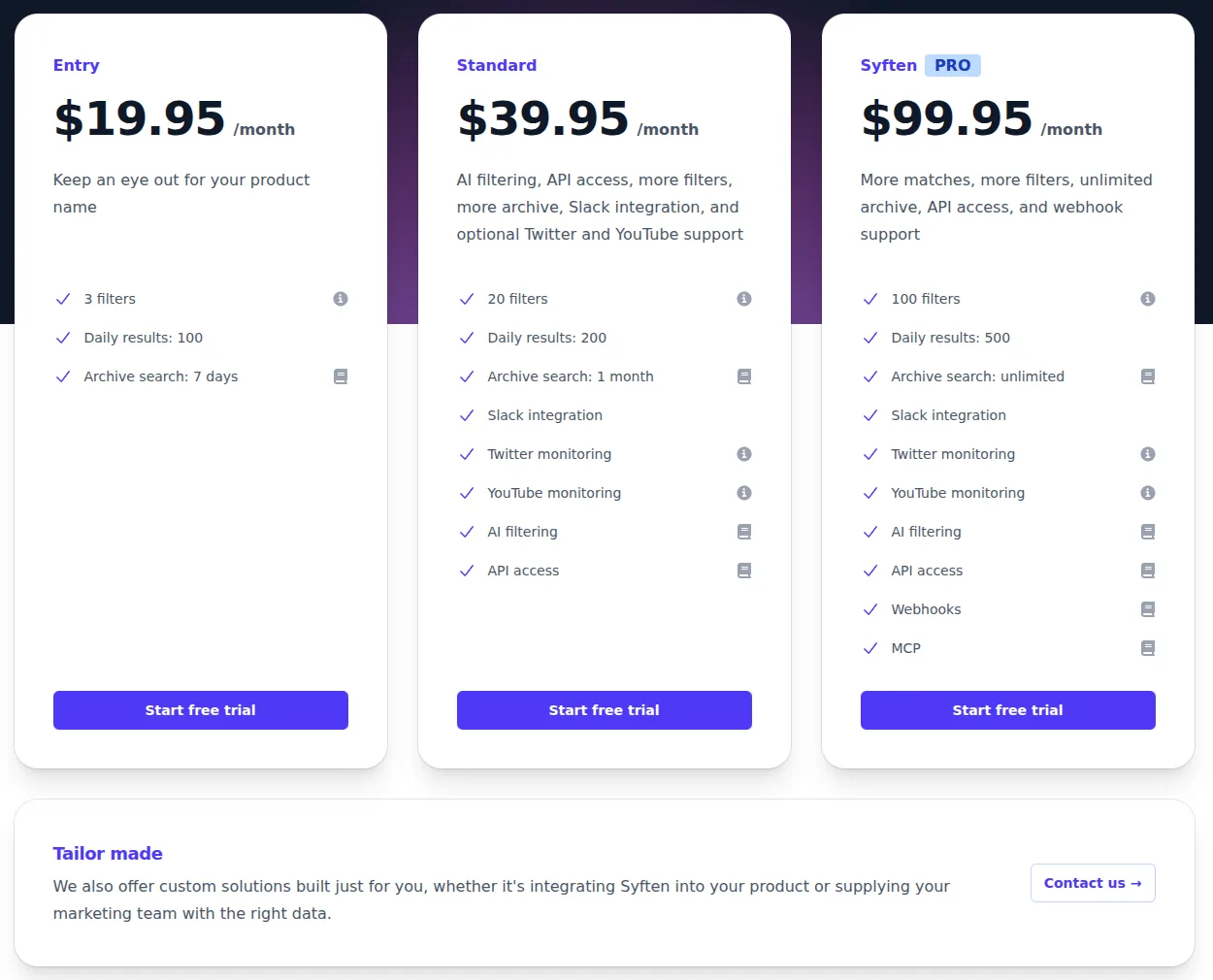
Source: Syften
Integrations and workflow ownership
Integration depth matters most after the first few weeks, when insights and alerts need to flow into the rest of the team's work.
Brandwatch is strongest when Brandwatch itself is the research workspace. Analysts build queries, dashboards, and reports inside the platform, then distribute the resulting insight to stakeholders.
Meltwater is strongest when Meltwater is the communications workspace. Media monitoring, alerts, reports, exports, and PR-adjacent workflows stay close together, which helps teams that already think in terms of coverage, reach, sentiment, and reputation.
Syften assumes it is part of your stack, not the center of it. Slack, email, RSS, API, Zapier, and webhooks are enough for most teams that want alerts to land where work already happens.
Common buying mistakes
The expensive mistake is comparing source counts without comparing the work required after a match appears.
Mistake 1: buying Brandwatch for simple mention alerts. If you mainly need "tell me when someone asks for an alternative to our competitor," Brandwatch can do far more than you need. The extra power only helps if someone will use it for research.
Mistake 2: buying Meltwater for one narrow social channel problem. Meltwater makes sense when communications teams need broad media context. It is less compelling when the only pain is missing Reddit, Hacker News, or forum conversations.
Mistake 3: choosing Syften when you need executive-ready media intelligence. Syften is intentionally narrow. If leadership expects share-of-voice reports, broadcast monitoring, journalist workflows, or AI visibility dashboards, Brandwatch or Meltwater will fit that brief better.
Brandwatch vs Meltwater: Which should you choose?
The cleaner choice starts with the owner of the work.
Choose Brandwatch if:
- Insights, research, or social intelligence owns the problem
- You need audience analysis, historical social data, and customizable dashboards
- You want AI help with query writing, summaries, trends, and post analysis
- Your output is a report, insight brief, campaign decision, or market read
- You have a team that will maintain searches and interpret results over time
Explore Brandwatch Consumer Intelligence
Choose Meltwater if:
- PR, communications, or media intelligence owns the problem
- You need monitoring across news, social, print, broadcast, podcasts, forums, blogs, and LLMs
- Coverage reports, reputation tracking, and real-time media alerts matter
- AI visibility tracking is part of your communications brief
- You are comfortable with tailored pricing and a demo-led purchase
See Meltwater media monitoring
Choose Syften if:
- You need specific alerts, not broad analytics
- The public web, Reddit, Hacker News, GitHub, forums, X/Twitter, or niche communities matter to your market
- You want to reply to relevant threads while they are still active
- Your budget is closer to $20-$100/month than an enterprise contract
- You want to be productive immediately instead of training on a suite
Start Syften's 14-day free trial
Brandwatch and Meltwater are large choices. They make sense when your team has a recurring research, media intelligence, or communications workflow.
If your actual need is narrower, do not buy the whole suite by default. A small team that wants to catch questions, complaints, competitor mentions, and recommendation threads may get more value from Syften than from another analytics dashboard.
For adjacent comparisons, see Talkwalker vs Brandwatch, Cision vs Meltwater, and the Reddit monitoring guide.
Brandwatch vs Meltwater FAQ
Is Brandwatch better than Meltwater?
Brandwatch is better when the primary job is consumer intelligence, audience research, social analytics, and insight reporting. Meltwater is better when the primary job is media intelligence, PR monitoring, communications reporting, and AI visibility tracking.
Which is better for social listening?
Brandwatch is usually the stronger social listening choice for deep research, historical analysis, audience segmentation, and social intelligence. Meltwater is stronger when social listening needs to sit alongside news monitoring, broadcast, print, PR reporting, and communications workflows.
Can you trust sentiment analysis in Brandwatch or Meltwater?
Use sentiment analysis as a directional research layer, not as a final verdict. Brandwatch and Meltwater can analyze large datasets, but sentiment gets harder when a post or article mentions a company, a competitor, a product category, and the market in one place. The buyer should ask what entity the sentiment is attached to and how ambiguous mentions are handled. We explain the issue in our sentiment analysis guide.
Which is better for PR and media monitoring?
Meltwater is the stronger default for PR and media monitoring because its product is organized around global coverage, alerts, reports, reach, reputation, media formats, and communications workflows. Brandwatch can support media and social insight work, but its clearest strength is consumer intelligence.
Does Brandwatch or Meltwater publish pricing?
Neither vendor publishes a simple public price list for the full platform. Brandwatch is demo-led. Meltwater says pricing is tailored to goals, modules, source breadth, data volume, users, integrations, onboarding, support, and contract terms.
Which platform tracks AI assistant visibility?
Meltwater's GenAI Lens is explicitly built for tracking how major LLMs and AI assistants describe your brand, products, competitors, and topics. Brandwatch's Iris AI is more focused on helping teams search, analyze, summarize, and act on consumer and social data.
What is a simpler alternative to Brandwatch and Meltwater?
If you need consumer intelligence or media intelligence, Brandwatch and Meltwater are better fits. If you need fast keyword alerts from the public web and communities like Reddit, Hacker News, GitHub, forums, blogs, and X/Twitter, Syften is a simpler alternative.
If Reddit is the specific channel you care about, compare dedicated options in our guide to the best Reddit monitoring tools before buying a broad listening suite.
This comparison was fact-checked and refreshed in May 2026 against current pricing and product pages. Pricing, feature packaging, and enterprise contract terms can change, so verify current details with each platform before buying.