Talkwalker and Brandwatch are both enterprise-grade social listening platforms, but they are bought for slightly different jobs. Talkwalker is strongest when a team needs broad media intelligence, visual listening, and Hootsuite-connected social workflows. Brandwatch is strongest when a team needs consumer research, historical conversation analysis, audience intelligence, and social media management in one suite.
The short version:
- Choose Talkwalker when media monitoring, visual recognition, speech recognition, and Hootsuite integration are central to the brief.
- Choose Brandwatch when consumer intelligence, audience research, historical social data, and connected publishing workflows matter most.
- Choose Syften when you do not need an enterprise research suite and mainly want fast alerts from the public web, Reddit, Hacker News, GitHub, forums, blogs, and X/Twitter.
That last distinction matters. Many teams searching for Talkwalker vs Brandwatch are not really choosing between two analyst platforms. They are trying to find prospects, complaints, product feedback, and competitor mentions while there is still time to reply. For that job, Syften is intentionally narrower and much faster to adopt.
This comparison focuses on the Talkwalker vs Brandwatch decision first, then shows where a focused alerting tool is the better fit.
Table of contents:
- Talkwalker vs Brandwatch at a glance
- The real difference: media intelligence vs consumer research
- What the workflow looks like in practice
- Where Talkwalker fits best
- Where Brandwatch fits best
- Where Syften fits best
- AI features: TalkwalkerAI vs Iris AI vs alert filtering
- Visual and audio monitoring
- Pricing and contract friction
- Common buying mistakes
- Talkwalker vs Brandwatch: Which should you choose?
- Talkwalker vs Brandwatch FAQ
Talkwalker vs Brandwatch at a glance
| Talkwalker | Brandwatch | Syften | |
|---|---|---|---|
| Core focus | Media intelligence, social listening, visual/audio monitoring | Digital consumer intelligence, audience research, social workflows | Fast alerts from high-intent community conversations |
| Data sources | 150 million data sources, 30+ social platforms, 187 languages, 196 countries | 1.7 trillion historical conversations, 501 million new conversations/day, 100 million unique sites | The public web, Reddit, Hacker News, GitHub, forums, blogs, X/Twitter, and more |
| Starting price | Quote required | Quote required | $19.95/month |
| Free trial | Demo required | Demo required | 14 days |
| Primary AI use | Summaries, insights, AI agents, LLM insights, and analysis apps | Ask Iris, AI query writing, summaries, content assistance | Filtering and routing alerts to useful conversations |
| Visual analysis | Strong logo, object, scene, image, video, and speech recognition | Image analysis for logos, objects, actions, and scenes | Text-focused |
| Buying motion | Demo and custom quote | Demo and custom quote | Self-serve with public pricing and 14-day trial |
| Best buyer | Enterprise brands, agencies, PR teams, and Hootsuite customers | Insights, research, marketing, and social teams at larger companies | Founders, marketers, support leads, and small B2B teams |
| Main risk | Buying enterprise analysis when you only need timely alerts | Buying a research suite without analyst capacity | Too narrow if you need global media intelligence or visual monitoring |
The real difference: media intelligence vs consumer research
Talkwalker vs Brandwatch is not a simple "which one has more mentions?" comparison. Both platforms cover large volumes of social and web data. The difference is how each product wants that data to be used.
Talkwalker says its plans cover 150 million data sources, 30+ social platforms, 187 languages, and 196 countries. That breadth supports brand health reporting, campaign analysis, crisis detection, and global media monitoring.
Brandwatch says its Consumer Intelligence product includes 1.7 trillion historical conversations back to 2010, 501 million new conversations added every day, official firehose access to Twitter, Tumblr, and Reddit, and conversations from 100 million unique sites. That makes Brandwatch especially relevant when the job is research: audience segmentation, trend discovery, market analysis, campaign measurement, and category monitoring.
In practice, Talkwalker feels closer to media intelligence plus social listening. Brandwatch feels closer to consumer research plus social operations. That distinction is more useful than trying to count every feature.
What the workflow looks like in practice
The easiest way to choose is to picture the first month after buying the tool.
A Talkwalker workflow starts with a monitoring brief: brand reputation, a launch, a sponsorship, a crisis risk, or a global campaign. A team tracks topics across social, news, blogs, forums, visual content, video, podcasts, print, and broadcast. Dashboards and alerts help the team decide what changed, where the risk is, and which stakeholder needs the update.
A Brandwatch workflow starts with a research question: which audiences care about this category, what is changing in the conversation, how does sentiment differ by segment, or what are competitors doing well? An analyst builds queries, cleans the data, uses dashboards and Iris AI to find patterns, then turns the result into a brief for marketing, product, or leadership. That kind of work needs human review because sentiment can be wrong when a post mentions several products, quotes someone else, or uses sarcasm.
A Syften workflow starts with a reply opportunity. A founder, marketer, or support lead tracks phrases like "alternative to [competitor]", "[category] recommendation", or a product domain. When a match appears, it lands in Slack, email, RSS, API, Zapier, or a webhook with a link to the thread. The value is catching a conversation while it is still active.

Source: Syften
This is the key buying question: do you need an intelligence platform for research, or an alerting system for participation?
Where Talkwalker fits best
Talkwalker is the better fit when the monitoring brief includes social, news, blogs, forums, video, podcasts, broadcast, print, and images. It is a serious option for global brands, agencies, PR teams, and marketing departments that need to understand what is happening across many channels.
The Hootsuite connection also matters. If your team already uses Hootsuite for publishing, engagement, or social customer care, Talkwalker can fit into a broader social media management environment.
Talkwalker is easiest to justify when insight is feeding brand strategy, reputation management, competitive intelligence, campaign measurement, or executive reporting. It is harder to justify when the actual job is "tell me when someone on Reddit asks for an alternative to our competitor."
The buyer objection to take seriously is ownership. Talkwalker can surface a lot of signal, but someone still has to maintain topics, review dashboards, tune alerts, and decide whether a spike is a crisis, a campaign effect, or noise.

Source: Talkwalker
Where Brandwatch fits best
Brandwatch is the better fit when the work looks like consumer research. Its value comes from exploring large historical datasets, building audience segments, tracking trends, comparing competitors, and turning social conversations into research outputs.
It is also useful when a team wants listening, social media management, influencer marketing, and reporting from one vendor. The more your team needs collaboration, publishing workflows, dashboards, and scheduled reporting, the easier Brandwatch is to defend.

Source: Brandwatch
Brandwatch is weaker when the buying team does not have analyst time. Without query discipline and reporting ownership, a consumer intelligence suite can become an expensive search box.
The buyer objection to take seriously is scope. Brandwatch can support social management, influencer workflows, search intelligence, and media intelligence too, but the more modules you add, the more the purchase becomes an operating model decision instead of a tool decision.
Where Syften fits best
Syften fits a different use case: finding conversations worth joining. It monitors places where people ask for recommendations, complain about tools, compare alternatives, describe problems, and talk through buying decisions.
That makes it useful for founders, developer tool companies, small B2B teams, indie hackers, and support-led growth teams. You do not get enterprise dashboards, visual recognition, or analyst workbenches. You get a steady stream of relevant threads from sources such as Reddit, Hacker News, GitHub, forums, blogs, and X/Twitter.
Syften is best when speed and specificity matter more than historical breadth. A single useful Reddit thread, Hacker News comment, GitHub issue, or forum post can be more valuable than another weekly dashboard.
The buyer objection to take seriously is reporting. If leadership expects polished share-of-voice reports, visual monitoring, or multi-market dashboards, Syften is too narrow. If the team wants alerts that can turn into replies, it is the more direct fit.
AI features: TalkwalkerAI vs Iris AI vs alert filtering
Talkwalker and Brandwatch both use AI to make large datasets easier to query and summarize. The difference is mostly packaging and workflow.
Talkwalker's current plan page lists TalkwalkerAI, AI Agent, LLM Insights, IQ Apps, and AI Summaries across its Core, Analyze, and Business tiers. That points to an AI layer built around enterprise analysis, summary generation, and broader intelligence workflows.

Source: Talkwalker
Brandwatch's Iris AI is framed around faster research and social workflows: asking questions, writing queries, summarizing conversations, drafting content, analyzing competitor posts, and helping with replies.

Source: Brandwatch
Syften uses a narrower AI/filtering posture. The goal is not to generate a research brief from a huge dataset. The goal is to reduce irrelevant matches and route specific conversations to the person who can answer them.
That is why AI comparisons should start with the output. If the desired output is a board-ready insight report, Talkwalker or Brandwatch makes sense. If the desired output is "open this thread and reply," Syften is the more direct tool.
Visual and audio monitoring
Visual and audio monitoring is one of the clearest reasons to choose an enterprise platform.
Talkwalker describes its visual and speech recognition as AI that can identify brands, scenes, objects, and products in images and videos, plus speech in video and podcasts. It says the system can recognize more than 30,000 brands, scenes, objects, and products and analyze more than 50 million videos each day.

Source: Talkwalker
Brandwatch also offers image analysis for logos, objects, actions, and scenes. That is useful for consumer brands, sponsors, retail teams, and agencies that need to understand visual context rather than only text mentions.

Source: Brandwatch
Syften is text-focused. That is a limitation if Instagram, TikTok, video analysis, broadcast, sponsorship visibility, or logo recognition are part of the monitoring brief. It is usually not a limitation for public web, Reddit, Hacker News, GitHub, forums, and product-community monitoring.
Pricing and contract friction
Pricing is one of the simplest ways to understand the target customer.
Talkwalker does not publish list prices. Its pricing page shows Core, Analyze, and Business packages and asks buyers to request a quote. That is normal for enterprise software, but it means you should expect a sales process, onboarding conversation, and contract terms shaped around data access, topics, historical depth, and services.

Source: Talkwalker
Brandwatch also routes buyers through a demo-led plan page covering Consumer Intelligence, Social Media Management, and Influencer Marketing. It does not publish a self-serve starting price for the main enterprise products.
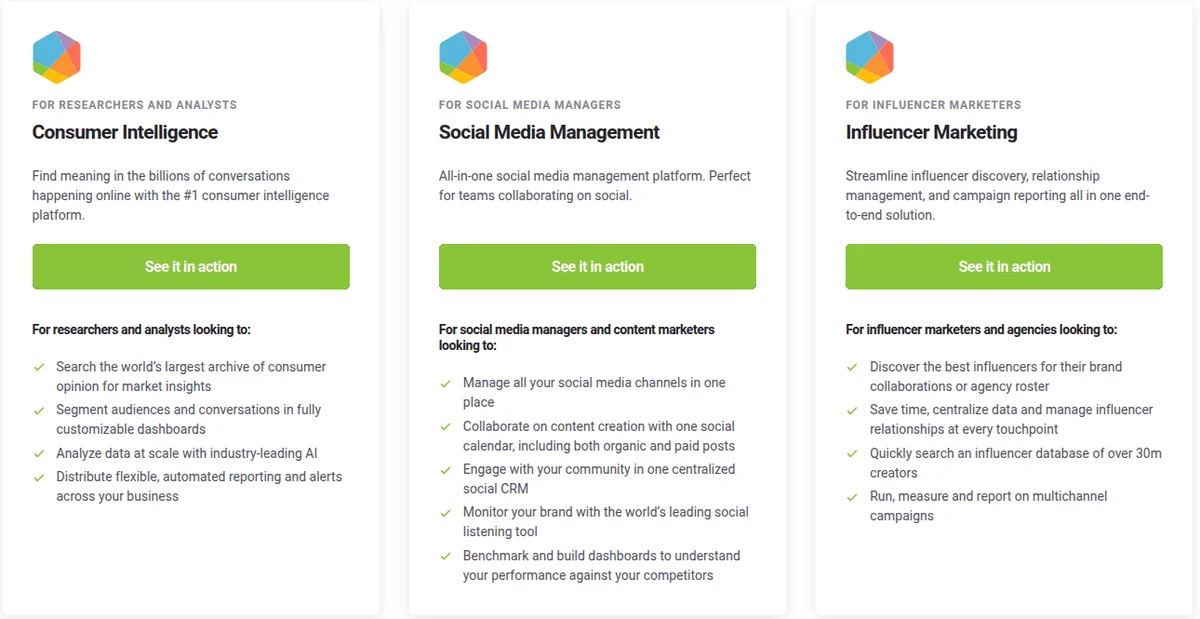
Source: Brandwatch
Syften publishes its prices: $19.95/month for Entry, $39.95/month for Standard, and $99.95/month for Pro. That changes the buying process. A small team can try it, judge the alert quality, and decide without a procurement cycle.
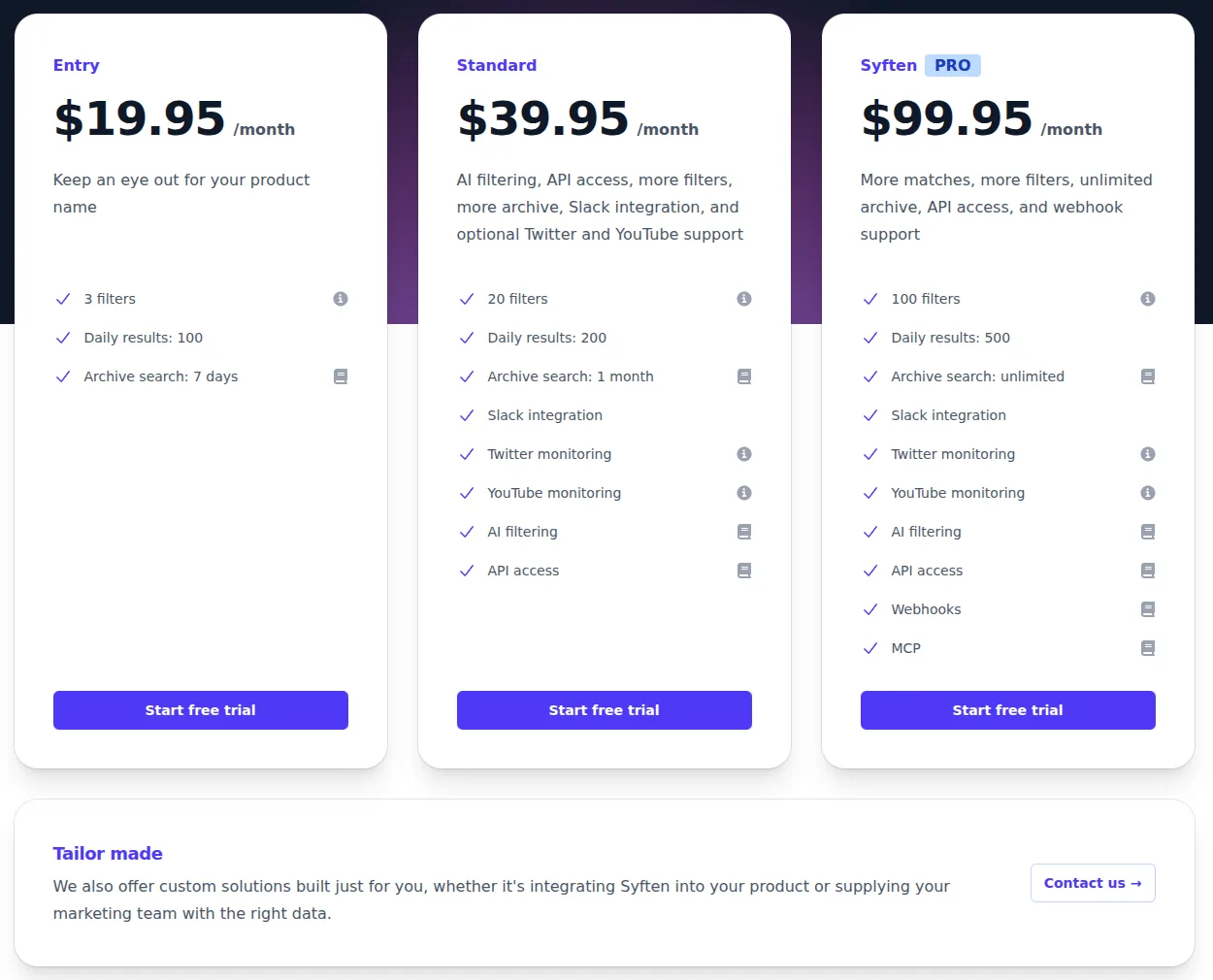
Source: Syften
Custom pricing is not bad by itself. If a global brand needs global data rights, onboarding, account management, and complex reporting, quote-based pricing can be appropriate. If the job is basic monitoring and outreach, it usually means the platform is more complex than the workflow requires.
Common buying mistakes
The first mistake is buying for source count instead of workflow. A larger data universe only helps if your team can turn it into decisions or conversations.
The second mistake is treating AI summaries as action. A summary can help an analyst understand a narrative, but it does not replace the work of replying, escalating, changing positioning, or fixing the product.
The third mistake is buying an enterprise suite for a founder-led motion. If the person who needs the alert is also the person who will reply, a focused alerting tool can be more useful than a dashboard with more charts.
The fourth mistake is underbuying when the brief is genuinely global. If you need visual monitoring, broadcast, print, historical consumer research, formal reporting, and cross-team workflows, Syften is too narrow and Talkwalker or Brandwatch is the correct class of product.
Talkwalker vs Brandwatch: Which should you choose?
Choose Talkwalker if:
- You need enterprise social listening plus media intelligence.
- Visual recognition, video, audio, podcasts, print, or broadcast monitoring matter.
- You already use Hootsuite or want listening connected to Hootsuite workflows.
- Your team has analysts or an agency partner to maintain queries and reports.
- You are buying for reputation, brand health, campaign analysis, or crisis monitoring.
Request a Talkwalker quote
Choose Brandwatch if:
- You need consumer intelligence and audience research.
- Historical social data and trend analysis are central to the job.
- You want listening, social media management, influencer workflows, and reporting from one vendor.
- Your team has enough analyst or social operations capacity to use the suite properly.
- You are comparing products, categories, competitors, campaigns, or audience segments over time.
Schedule a Brandwatch demo
Choose Syften if:
- You want to find relevant conversations quickly instead of building research dashboards.
- Your best opportunities happen on the public web, Reddit, Hacker News, GitHub, forums, blogs, or X/Twitter.
- You care about competitor alternatives, pain-point keywords, product feedback, and recommendation threads.
- You need public pricing, self-serve setup, and a short path from alert to reply.
- You are a founder, small team, or B2B marketer who will personally act on the alerts.
For most enterprise buyers, the Talkwalker vs Brandwatch decision comes down to the center of gravity. Pick Talkwalker for broad media intelligence and visual/audio monitoring. Pick Brandwatch for consumer research and social workflows.
For smaller teams, the better question is whether you need either platform yet. If your next useful outcome is one relevant thread you can answer today, start with Syften and graduate to an enterprise suite when your reporting needs outgrow alerting.
For adjacent comparisons, see Hootsuite vs Brandwatch, Brandwatch vs Meltwater, and the Reddit monitoring guide.
Talkwalker vs Brandwatch FAQ
Is Talkwalker better than Brandwatch?
Talkwalker is better when the main job is broad media intelligence, visual and audio monitoring, reputation tracking, and Hootsuite-connected social workflows. Brandwatch is better when the main job is consumer intelligence, audience research, historical social analysis, and social media management.
Which platform has better data coverage?
Talkwalker is broader for global media intelligence, with social, web, print, broadcast, podcast, video, image, and language coverage. Brandwatch is stronger for historical consumer research, with 1.7 trillion historical conversations back to 2010, 501 million new conversations added daily, and official firehose access to Twitter, Tumblr, and Reddit.
Can you trust sentiment analysis in Talkwalker or Brandwatch?
Sentiment analysis in enterprise tools can be useful for trend discovery, but it still needs analyst review. The bigger the dataset, the easier it is for a clean sentiment chart to hide messy examples: sarcasm, quotes, competitor comparisons, or posts that mention several brands. Buyers should ask whether sentiment is classified for a specific entity and how false positives are reviewed. For the underlying pitfall, read why sentiment analysis is often misleading.
Which is better for visual and audio monitoring?
Talkwalker is the stronger default for visual and audio monitoring. Its visual listening page describes recognition across brands, scenes, objects, products, videos, and speech, including 30,000 searchable visual categories and more than 50 million videos analyzed each day.
Does Talkwalker or Brandwatch publish pricing?
Neither Talkwalker nor Brandwatch publishes a simple self-serve price list for the main enterprise products. Talkwalker asks buyers to pick Core, Analyze, or Business and request a custom quote. Brandwatch routes buyers through a demo-led plan page.
What is a simpler alternative to Talkwalker and Brandwatch?
If you need enterprise media intelligence or consumer research, Talkwalker and Brandwatch are better fits. If you need fast keyword alerts from the public web and communities like Reddit, Hacker News, GitHub, forums, blogs, and X/Twitter, Syften is a simpler alternative.
If Reddit is the specific channel you care about, compare dedicated options in our guide to the best Reddit monitoring tools before buying a broad listening suite.
This comparison was fact-checked and refreshed in May 2026 against current pricing and product pages. Pricing, feature packaging, and enterprise contract terms can change, so verify current details with each platform before buying.