Brand24 is the better default for most teams that want practical brand monitoring. Brandwatch is the better fit when social listening is part of an enterprise research program.
Both tools help teams monitor online conversations, but they are not built for the same buyer. Brand24 is the more approachable brand monitoring tool for marketers, PR teams, agencies, and growing companies. Brandwatch is the enterprise consumer intelligence suite for teams that need historical research, audience segmentation, custom dashboards, and social workflows at scale.
The short version:
- Choose Brand24 when you want self-serve social listening, sentiment, alerts, AI summaries, and reports without an enterprise implementation.
- Choose Brandwatch when you need consumer intelligence, historical social research, audience analysis, publishing workflows, and a larger social suite.
- Choose Syften when you do not need a listening dashboard and mainly want fast alerts from the public web, Reddit, Hacker News, GitHub, forums, blogs, and X/Twitter.
That distinction matters because many people searching for Brand24 vs Brandwatch are not only comparing feature depth. They are deciding whether they need a monitoring dashboard, an enterprise research system, or a lightweight way to catch conversations while they are still active.
This comparison focuses on the Brand24 vs Brandwatch decision first, then shows when Syften is the more direct alternative.
Table of contents:
- Brand24 vs Brandwatch at a glance
- The real difference: brand monitoring vs consumer intelligence
- What the workflow looks like in practice
- Where Brand24 fits best
- Where Brandwatch fits best
- Where Syften fits best
- AI features: Brand24 AI, Iris AI, and Syften filtering
- Pricing and buying friction
- Data coverage and source quality
- Common buying mistakes
- Brand24 vs Brandwatch: Which should you choose?
- Brand24 vs Brandwatch FAQ
Brand24 vs Brandwatch at a glance
| Brand24 | Brandwatch | Syften | |
|---|---|---|---|
| Core focus | Self-serve brand monitoring, alerts, sentiment, reports, AI insights | Enterprise consumer intelligence, audience research, social workflows | Fast alerts from high-intent community conversations |
| Starting price | $249/month, or $199/month billed annually | Quote required | $19.95/month |
| Free trial | 14 days, no credit card required | Demo-led buying path | 14 days |
| Data coverage | Social, news, blogs, Reddit, LinkedIn, YouTube, TikTok, reviews, podcasts, and more | 1.7 trillion historical conversations, 501 million new conversations/day, 100 million unique sites | The public web, Reddit, Hacker News, GitHub, forums, blogs, X/Twitter, and more |
| Update speed | Every 12h on Individual, hourly on Team, realtime on Pro and above | Built for real-time and historical enterprise research | Built for timely alerts into Slack, email, RSS, API, Zapier, or webhooks |
| Primary AI use | Sentiment, AI Events Detection, AI Brand Assistant, AI Insights, AI Topics | Iris AI for search, query writing, summaries, insights, writing, and post analysis | Filtering and routing alerts to useful conversations |
| Best buyer | Marketers, PR teams, agencies, SaaS teams, growing businesses | Insights, research, social intelligence, and enterprise social teams | Founders, marketers, support leads, and small B2B teams |
| Main risk | Paying for reports when the team only needs a few reply opportunities | Buying an enterprise suite without analyst capacity | Too narrow if you need formal reporting, broad sentiment analysis, or audience research |
The real difference: brand monitoring vs consumer intelligence
Brand24 vs Brandwatch is not mainly a budget comparison. It is a workflow comparison.
Brand24 is organized around monitoring, analyzing, and reporting on mentions. Its feature set includes alerts, sentiment, reach, share of voice, reports, influencer analysis, anomaly detection, AI Insights, Topic Analysis, and AI Brand Assistant. That makes it useful when a marketing or PR team wants a practical dashboard for brand, campaign, competitor, or reputation monitoring.
Brandwatch is organized around consumer intelligence: using large social and web datasets to understand audiences, markets, competitors, and behavior. It says its data foundation includes 1.7 trillion historical conversations back to 2010, 501 million new conversations added every day, official firehose access to Twitter, Tumblr, and Reddit, and conversations from 100 million unique sites. That makes it relevant when the job is research: audience segmentation, market analysis, trend discovery, category tracking, and executive-ready insight production.
Syften starts from a narrower question: which web mentions should someone review, and which public conversations should someone answer now? That is not a replacement for Brand24 reporting or Brandwatch research. It is a different job.
What the workflow looks like in practice
The easiest way to choose is to picture the first month after buying the tool.
A Brand24 workflow starts with tracked keywords: your brand, competitors, campaign names, executives, or category terms. The team reviews the Mentions Feed, filters by source or sentiment, checks spikes, uses AI summaries or reports to explain what changed, and sends stakeholders a digest.
For example, an agency might track a client brand, two competitors, a campaign hashtag, and a product category. The first useful output is usually a report: mention volume changed, sentiment shifted, a high-reach post appeared, or a specific source started driving discussion.
A Brandwatch workflow starts with a research question: how is a market changing, which audience segments care, what themes explain a spike, how does a competitor compare, or what can a campaign teach the business? An analyst builds queries, cleans data, uses dashboards and Iris AI to find patterns, then turns the result into a brief or ongoing reporting program.
For example, a consumer insights team might compare conversation themes across markets, separate complaints from purchase intent, segment audiences by interests, then brief product or marketing on what changed. The value is the interpreted insight, not the raw alert.
A Syften workflow starts with a reply opportunity. A founder, marketer, or support lead tracks phrases like "alternative to [competitor]", "[category] recommendation", or a product domain. When a match appears, it lands in Slack, email, RSS, API, Zapier, or a webhook with a link to the thread.
For example, a founder might track "Brand24 alternative", "Brandwatch pricing", or "Reddit monitoring tool" and reply only when the thread is specific enough to help. The value is speed and relevance, not another weekly chart.
Where Brand24 fits best
Brand24 fits best when the team wants useful monitoring without enterprise overhead.
The product is strongest for brand monitoring, campaign monitoring, PR coverage, competitor tracking, sentiment review, influence analysis, and recurring stakeholder reports. It is more structured than a simple keyword alert, but it does not require the analyst-heavy setup that Brandwatch can.

Source: Brand24
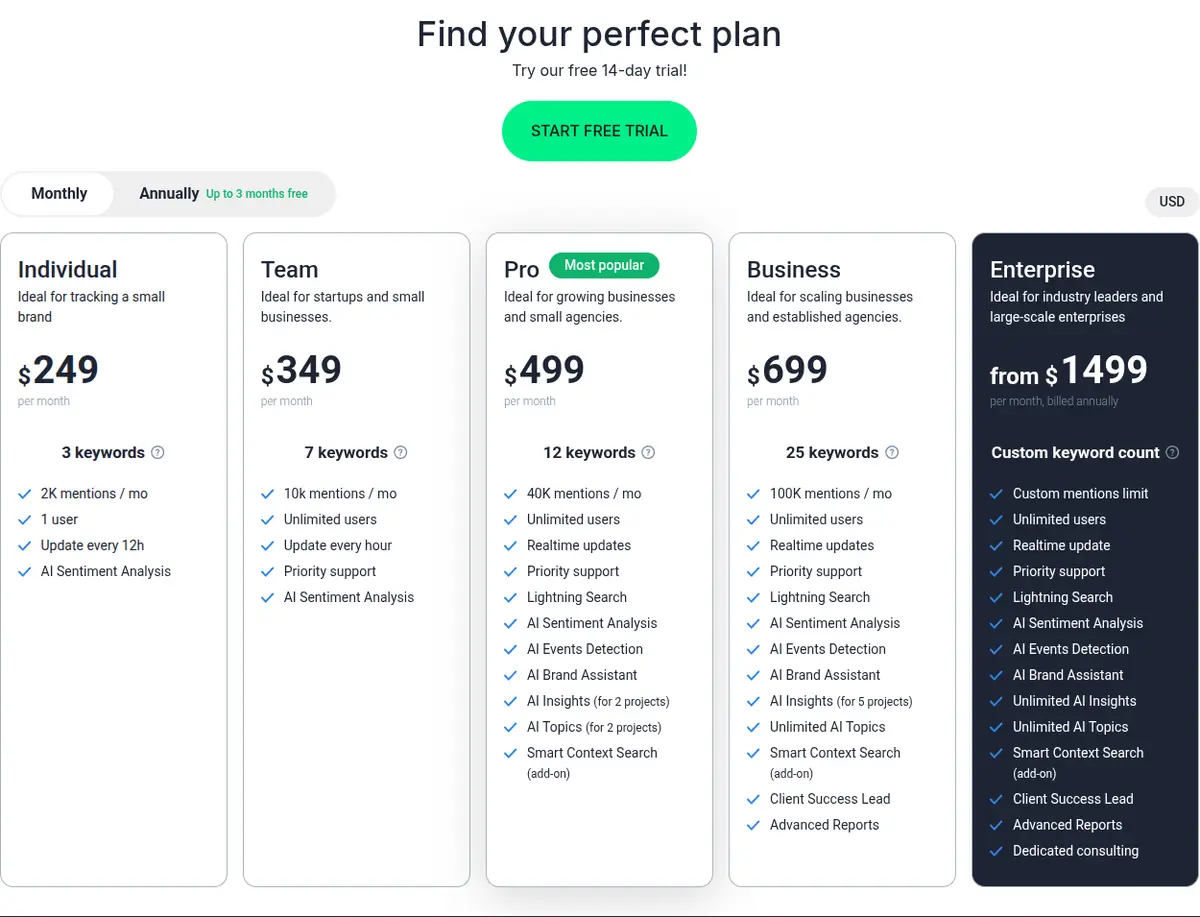
Brand24's public pricing also fits this middle market. Its plan page lists Individual at $249/month, Team at $349/month, Pro at $499/month, Business at $699/month, and Enterprise from $1,499/month, with annual discounts on the self-serve tiers and a 14-day trial.

Source: Brand24
The buyer objection to take seriously is output. If no one needs sentiment charts, reports, share-of-voice context, or campaign monitoring, Brand24 may still be more dashboard than you need. And if people do need sentiment charts, they should know whether the chart is measuring sentiment toward the brand, a competitor, a product category, or just the whole sentence.
Where Brandwatch fits best
Brandwatch fits best when the work is consumer intelligence, audience research, social intelligence, and enterprise social operations.
Its strength is not just "more mentions." It is the ability to ask larger questions across a bigger historical dataset, segment audiences, build custom dashboards, use image analysis, and connect listening to social media management, influencer marketing, and reporting workflows.

Source: Brandwatch
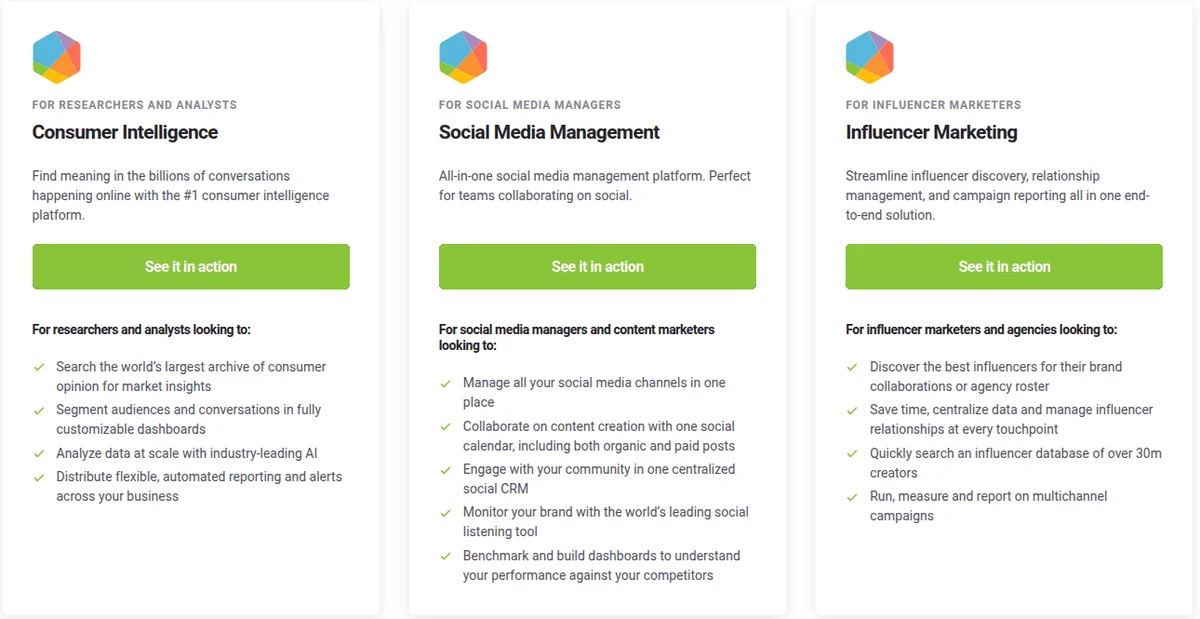
Brandwatch's plan page groups products around Consumer Intelligence, Social Media Management, Influencer Marketing, Search Intelligence, and Media Intelligence & Insights. That breadth is useful when a larger team wants one vendor for several social and research workflows.
The buyer objection to take seriously is analyst capacity. Brandwatch can answer more sophisticated questions, but sophisticated questions require query design, taxonomy decisions, exclusions, dashboards, interpretation, and stakeholder follow-up.
Where Syften fits best
Syften fits best when the desired output is a conversation, not a report.
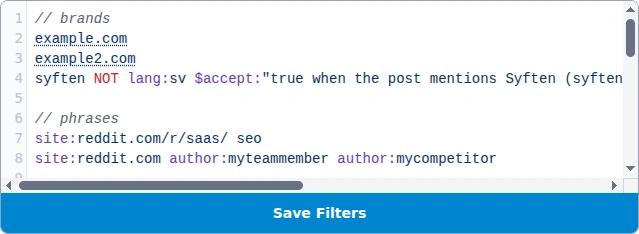
That makes it useful for founders, developer tool companies, small B2B teams, indie hackers, and support-led growth teams. You can monitor sources such as Reddit, Hacker News, GitHub, forums, blogs, and X/Twitter, then route alerts to the places where your team already works.
Source: Syften
The search syntax lets a small team narrow broad topics into specific, answerable alerts, such as "Brand24 alternative", "Brandwatch pricing", or "tool for tracking Reddit mentions". The useful moment is often the first hour of a thread, not the next weekly report.
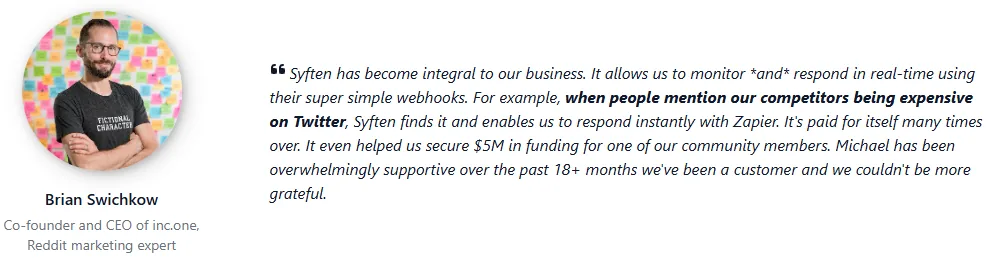
The buyer objection to take seriously is reporting. Syften is intentionally narrow. If leadership expects share-of-voice reporting, sentiment dashboards, media coverage summaries, or audience research, Brand24 or Brandwatch is the better class of product. That does not make sentiment dashboards automatically reliable; it just means the buyer is in the reporting category where those dashboards are expected.
AI features: Brand24 AI, Iris AI, and Syften filtering
AI matters only when it helps someone make a decision faster.
Brand24 packages AI around monitoring productivity. Its pricing page lists AI Sentiment Analysis on all plans, while Pro and higher plans add AI Events Detection, AI Brand Assistant, AI Insights, and AI Topics. Its feature page describes AI Insights for trends and recommendations, Topic Analysis for themes, and Anomaly Detection for unusual spikes or drops.
Brandwatch's Iris AI is aimed at deeper research and social workflows. Brandwatch describes Iris AI as helping teams ask questions, search data, write Boolean queries with keyword, hashtag, and subreddit recommendations, summarize trends and anomalies, draft social content, and analyze competitor posts.
Syften uses AI/filtering more narrowly. The goal is not to generate a market research brief. The goal is to reduce irrelevant matches and route specific conversations to the person who can answer them.
Pricing and buying friction
Pricing makes the target customer obvious.
Brand24 publishes its prices. Individual is $249/month, or $199/month billed annually, and includes 3 keywords, 2,000 mentions/month, 1 user, updates every 12 hours, and AI Sentiment Analysis. Team is $349/month, or $299/month billed annually, and adds 7 keywords, 10,000 mentions/month, unlimited users, hourly updates, and priority support. Pro is $499/month, or $399/month billed annually, and adds realtime updates, Lightning Search, AI Events Detection, AI Brand Assistant, AI Insights, and AI Topics.
Source: Brand24
Brandwatch does not publish a simple self-serve price list for Consumer Intelligence or its broader suite. The plan page routes buyers to a demo and asks which solution they are interested in: Social Media Management, Social Listening & Consumer Insights, Influencer Marketing, Search Intelligence, or Not Sure.
Source: Brandwatch
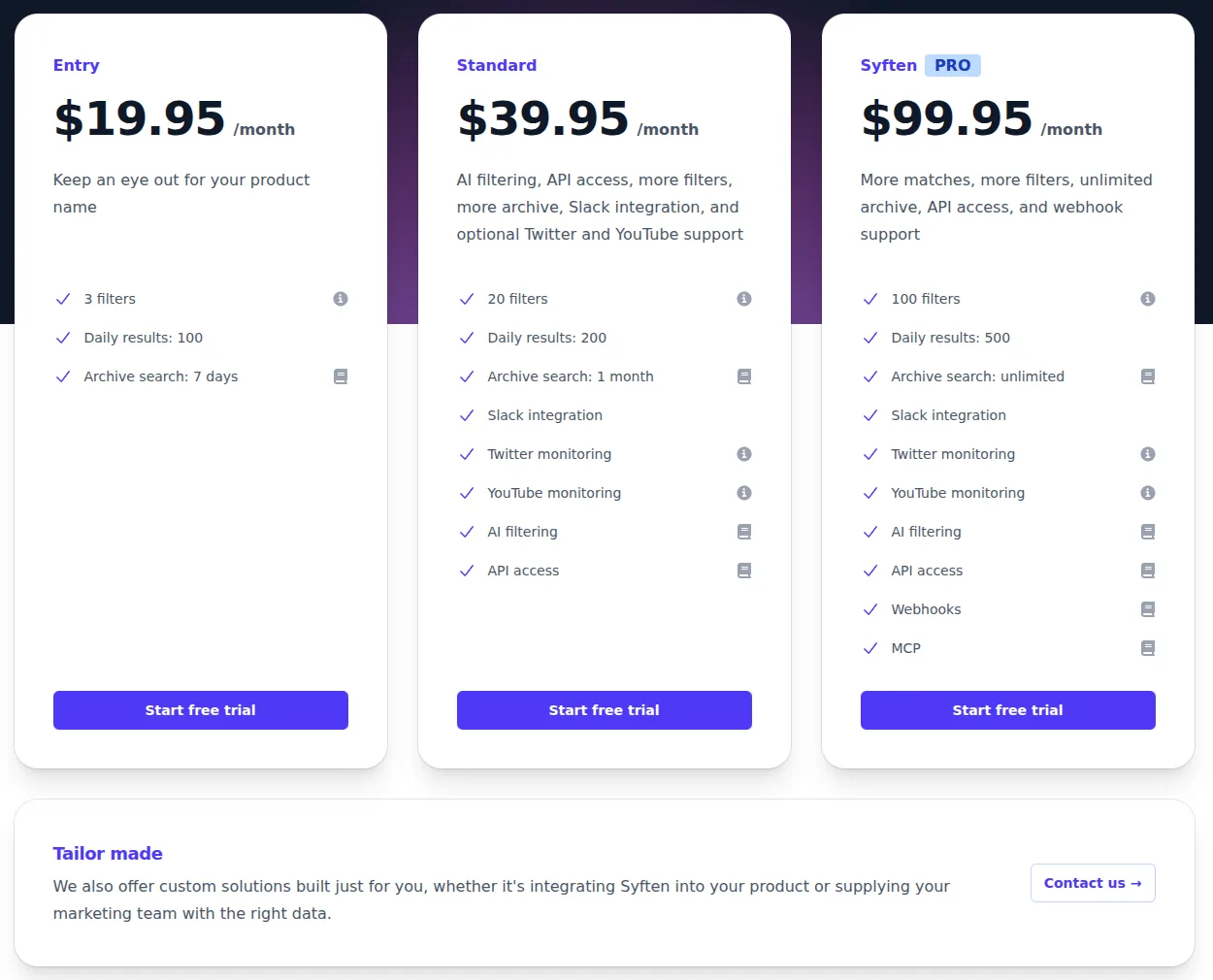
Syften starts at $19.95/month, with Standard at $39.95/month and Pro at $99.95/month. That lower price reflects a narrower product: keyword alerts and delivery, not a broad analytics suite.
Source: Syften
The practical question is not only "what can we afford?" It is "what will we actually staff?" A $249/month monitoring dashboard can be cheap if it replaces manual reporting. A quote-based research suite can be worthwhile if it informs major decisions. A $19.95/month alerting tool can be the better buy if one timely conversation is the whole point.
Data coverage and source quality
Source coverage matters less than whether the sources match the job.
Brand24's plan comparison lists sources such as Facebook, Instagram, X/Twitter, news, blogs, Reddit, LinkedIn, Medium, Quora, YouTube, TikTok, reviews, Twitch, newsletters, and podcasts. That is broad enough for most brand monitoring, PR, and campaign tracking work.
Brandwatch is deeper when historical consumer research matters. Its official firehose access to Twitter, Tumblr, and Reddit, large archive, and audience analysis features are useful when analysts need to compare markets, segments, competitors, and trends over time.
Syften is narrower on purpose. It focuses on communities where people ask questions, compare products, and discuss pain points. You will miss some broad web mentions, but you are more likely to see a thread while there is still time to reply.
Common buying mistakes
The expensive mistake is comparing feature lists without comparing the work required after the mention appears.
Mistake 1: buying Brand24 for a founder-led reply workflow. Brand24 can monitor and report on a lot of useful mentions, but if you mainly need "tell me when someone asks for an alternative to our competitor," you may not need a full monitoring dashboard.
Mistake 2: buying Brandwatch without analyst ownership. Brandwatch is powerful when someone owns query quality, audience segmentation, dashboards, reporting, and interpretation. Without that owner, the platform can produce more data than decisions.
Mistake 3: choosing Syften when you need formal brand monitoring. Syften is intentionally focused. If you need sentiment analysis, influence reports, campaign dashboards, or historical consumer research, Brand24 or Brandwatch will fit better.
Brand24 vs Brandwatch: Which should you choose?
Choose Brand24 if:
- You need practical brand monitoring with alerts, sentiment, and reports.
- Marketing, PR, or an agency team owns the workflow.
- You want public pricing and a 14-day self-serve trial.
- AI summaries, anomaly detection, and stakeholder reports would save time.
- Your budget starts around $199-$249/month rather than an enterprise contract.
Choose Brandwatch if:
- You need enterprise consumer intelligence and audience research.
- Historical social data and trend analysis are central to the job.
- You want listening, social media management, influencer workflows, and reporting from one vendor.
- Your team has analysts or social intelligence specialists to maintain searches and interpret results.
- The output is a market read, campaign decision, audience brief, or executive report.
Explore Brandwatch Consumer Intelligence
Choose Syften if:
- You need specific alerts, not broad analytics.
- The public web, Reddit, Hacker News, GitHub, forums, blogs, or X/Twitter matter to your market.
- You want to reply to relevant threads while they are still active.
- Your budget is closer to $20-$100/month than a monitoring-suite contract.
- Direct engagement matters more than sentiment reports.
Start Syften's 14-day free trial
For most buyers, the Brand24 vs Brandwatch decision comes down to operating weight. Brand24 is the more practical choice for brand monitoring and reporting. Brandwatch is the stronger choice for enterprise research and social intelligence.
For smaller teams, the better question is whether you need either dashboard yet. If your next useful outcome is one relevant thread you can answer today, start with Syften and move up to a listening suite when reporting needs outgrow alerting.
For adjacent comparisons, see Brand24 vs Mention, Brandwatch vs Meltwater, and the Reddit monitoring guide.
Brand24 vs Brandwatch FAQ
Is Brand24 better than Brandwatch?
Brand24 is better when you need self-serve brand monitoring, sentiment, alerts, reports, and AI summaries without enterprise complexity. Brandwatch is better when you need consumer intelligence, historical social research, audience segmentation, and enterprise social workflows.
Which is cheaper, Brand24 or Brandwatch?
Brand24 is more transparent and usually easier to budget. Its public pricing starts at $249/month, or $199/month billed annually. Brandwatch does not publish a simple self-serve price list for its main enterprise products and routes buyers through a demo-led process.
Which has better data coverage?
Brandwatch is stronger for historical consumer research, with 1.7 trillion historical conversations back to 2010, 501 million new conversations added every day, official firehose access to Twitter, Tumblr, and Reddit, and conversations from 100 million unique sites. Brand24 covers a broad practical set of monitoring sources, including major social networks, news, blogs, Reddit, reviews, YouTube, TikTok, newsletters, and podcasts.
Which is better for social listening?
Brand24 is the better fit for accessible social listening, alerts, sentiment, and reporting. Brandwatch is the better fit for deep social intelligence, consumer research, historical analysis, audience segmentation, and enterprise reporting.
Can you trust sentiment analysis in Brand24 or Brandwatch?
Buyers should treat sentiment analysis as a warning flag or review filter, not as a precise measurement. Brand24 is easier to adopt and Brandwatch is deeper for research, but both can produce sentiment outputs that are wrong when the model does not know whether the sentiment is about the brand, competitor, feature, or product category. For important decisions, review the actual mentions and ask how the vendor defines the sentiment target. Read why sentiment analysis is often unreliable.
Does Brand24 or Brandwatch monitor Reddit?
Both can include Reddit in social listening workflows. Brand24 lists Reddit in its plan comparison sources. Brandwatch says it has official firehose access to Reddit, along with Twitter and Tumblr. Syften is the simpler fit when Reddit monitoring is mainly about getting specific threads to answer.
If Reddit is the specific channel you care about, compare dedicated options in our guide to the best Reddit monitoring tools before buying a broad listening suite.
Is Brand24 good enough for agencies?
Brand24 is often the more practical agency choice when the work is campaign monitoring, brand mentions, sentiment, influencer analysis, client reports, and alerts. Brandwatch is more appropriate when the agency is delivering enterprise consumer research or social intelligence strategy.
When should a team upgrade from Brand24 to Brandwatch?
Consider Brandwatch when Brand24-style monitoring is no longer enough: you need deeper historical analysis, audience segmentation, custom research dashboards, image analysis, social media management workflows, or multiple teams using social data for strategic decisions.
What is a simpler alternative to Brand24 and Brandwatch?
If you need formal brand monitoring or consumer intelligence, Brand24 and Brandwatch are better fits. If you need fast keyword alerts from the public web and communities like Reddit, Hacker News, GitHub, forums, blogs, and X/Twitter, Syften is a simpler alternative.
This comparison was fact-checked and refreshed in May 2026 against current pricing and product pages. Pricing, feature packaging, and enterprise contract terms can change, so verify current details with each platform before buying.