You have several articles but nobody wants to share them. People are having a look but then leave never to return again. You don’t really know what to write about. You tried sharing your post on Reddit, but it withered and died with no upvotes. Or maybe it did attract some traffic - just not from the people interested in your services.
The easiest way to write something worth sharing is to start from a real question people already ask. Find the question first, write the useful answer second, and promote it where the question came from.
There is a process for that, but it requires some work.
Is it worth the effort?
Here is an article about writing style from this very blog. A few days ago it reached the number one spot on lobste.rs:
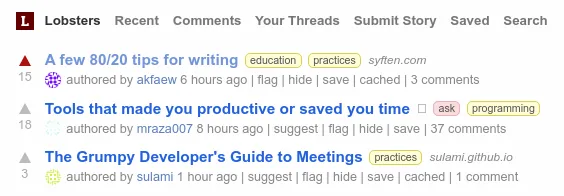
#1 on lobste.rs
That resulted in 150 visits and three sign-ups for me. Those that didn’t sign up yet might do so in the future. And that’s just one site.
This is evergreen content, too. The article contains timeless knowledge and can be used and reused. I can update it and reshare it when there is a relevant new discussion. I can rewrite it and use it as a guest post. I can use portions of it to answer questions in online forums. I put a lot of work into it once, and now I have a valuable marketing tool.
So without further ado…
Solve someone’s problem. Mention your product only when it helps
There’s a common misconception that you need to be a renowned expert to be able to help people on the internet. The only thing that you need is to be more knowledgeable in one particular area than the person you’re helping. Is there something you’ve spent months or years doing? Surely it’s conceivable someone else is only just starting. And even if not, nothing is stopping you from doing a little research.
The best articles make the reader feel understood like you are talking directly to them and solving their exact problem. Here’s how to achieve that effect.
1. Figure out where your audience hangs out
To look for topics that your audience is interested in we’ll need to do a little community research.
Where do they post? Forums, Slack channels, Facebook groups, subreddits - I have a big spreadsheet with over seventy communities. If you have clients, ask them. If not, do a little investigation.
2. Look for recurring topics
If someone took the effort to start a thread then something must have bothered them. If someone took the time to reply then they must have gone through it as well. If someone upvoted the thread then they must have benefited from the discussion.
If a particular topic pops up every few months and has a few comments and upvotes then you’ve found your topic.
3. Gather data and write a post
What are some common complaints? What do people wish they knew, but don’t? Is there any recurring advice? Write it down and you’ll have everything you need for a strong first draft.
When a friend asked me to review his write-up I happily obliged. Then I thought that I could make the reply into an article. I checked a few of my favourite communities for entrepreneurs and indeed, people were asking for writing advice. I collected some of that advice, added it to my own, and got a great piece of work. It reached the first spot both on Indie Hackers and Lobste.rs.
Here is how Lukasz from Personal Discount does it:
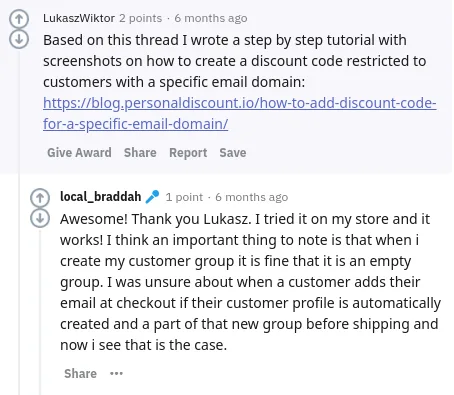
How Lukasz does it
For some additional insights watch the videos about the Sales Safari and Ebombs.
Convert traffic to subscribers
A useful article can still leak attention if it gives readers no next step. That matters because the purpose of a business blog is to sell. What’s the use of writing if people will come and go? Let’s see how we can make them stick around.
Add links to your other articles
This post from Mark Manson links liberally to his other articles. By the time you’re done with it, you’ll have more tabs open than you did the last time you had to check something on Wikipedia real quick.
Did you finish a new article? Update your old ones to mention it.
Add a CTA
How many problems did you encounter this week? How many of them have you solved by doing a Google search? Can you recall the names of any of the sites that helped you? While some websites support themselves with ads, that’s not you - you’re selling a product and you have to be remembered.
A CTA is a Call To Action. You can either ask the users to sign up for your mailing list or invite them to create an account. Add a Call To Action in the middle or at the bottom of your article.
Tailor it to your content
There is never an audience reading your article, it’s always just one person. That’s why you should maintain a conversational tone throughout your writing, and that includes your calls to action. Make it a logical conclusion of the article.
“Sign up for my mailing list” is nice, but I think the one I made at the bottom is better.
Explain what the user will gain
“Create a free account” seems good, but would anyone on their deathbed ever say “I wish I’d created more free accounts?”. I can, however, imagine someone saying “I wish I focused more on promotion”.
For this article I’d do something like: “Want to find questions people already ask about your product category? Set up a few alerts in Syften and turn the best discussions into articles worth sharing.”
Examples
Here is a great example of a CTA from Mark Manson’s Blog:

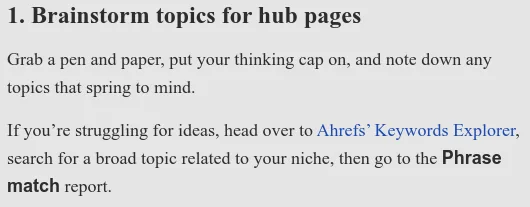
Ahrefs does more subtle calls to action:
Quality rating
I keep a list of my articles in a spreadsheet and rate them on the following scale:
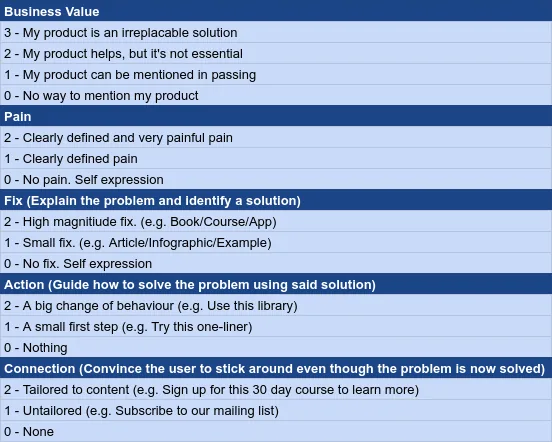
A quick text version of the checklist:
- Does it answer a real question people already ask?
- Would it still be useful if the product mention disappeared?
- Does it contain examples, screenshots, numbers, or a specific story?
- Can I reuse parts of it in replies without making people feel tricked into clicking?
- Would I share it if someone else wrote it?
How to promote your content
Writing a good article is the easy part. Getting the right people to see it is the hard part.
But you can’t rely on people stumbling upon your articles randomly. A common content-marketing rule of thumb says you should spend 20% of your time writing and 80% promoting.
See how to do content marketing next.