Product Hunt is worth launching on when you want feedback, social proof, early adopters, backlinks, newsletter subscribers, or a public milestone. It is a weak channel if your only goal is immediate revenue. A good Product Hunt launch strategy is to prepare the product, community, landing page, first comment, and follow-up before launch day, then treat the launch as one distribution event rather than the whole business.
This Product Hunt launch guide is deliberately practical, but also realistic. You can get thousands of visitors and still get no customers. You can also get a modest launch that produces useful feedback, links, reviews, partnerships, and a reason to keep talking about your product.
Product Hunt launch checklist
A Product Hunt launch works best when the visible launch page is only the final step. Do the boring work first:
- Create and warm up a personal Product Hunt account before launch. Product Hunt says new accounts need at least one week before they can post a product, and recommends joining much earlier.
- Set one primary goal: feedback, signups, trials, reviews, backlinks, investor attention, social proof, or revenue. Do not pretend all of them matter equally.
- Prepare a focused landing page. Remove distracting links, explain who the product is for, and make the next step obvious.
- Write the Product Hunt tagline, description, gallery, makers list, pricing, and promo offer before launch day.
- Prepare your first comment. Product Hunt says this is a highly visible part of the page and recommends using it to explain the product, the makers, the story, and the feedback you want.
- Tell your real audience before launch day. Product Hunt allows you to ask people to visit, comment, and give feedback. Do not ask for upvotes.
- Plan who will reply to comments during launch day. Fast, human replies matter more than refreshing the vote count.
- Track what happens after the launch: traffic, signup source, comments, reviews, social posts, backlinks, and conversations in communities like Reddit, Hacker News, Slack, and Indie Hackers.
Product Hunt launch strategy
The common mistake is treating Product Hunt like a slot machine. You launch, watch the leaderboard, and hope strangers turn into customers. That sometimes happens, but it is not a strategy.
A better strategy is to decide what kind of launch you are actually running. Different products need different campaigns.
Launch a real product when you need feedback
Product Hunt is full of makers, early adopters, product people, investors, and curious users. That audience can be useful if your product is ready for public criticism.
The right goal here is not “get Product of the Day or the launch failed”. The right goal is to learn who understands the product, which objection appears repeatedly, which use case gets people excited, and whether anyone bothers to come back after the initial novelty fades.
Launch a free side project when you need reach
Product Hunt users like useful and amusing things that are easy to try. That is why small tools, calculators, free templates, public databases, email courses, and non-obvious guides often travel better than serious paid SaaS products.
Here is a side project made by an Indie Hacker:
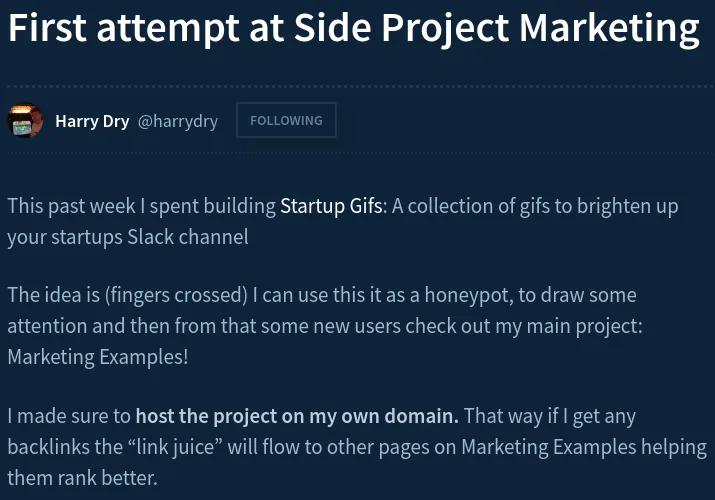
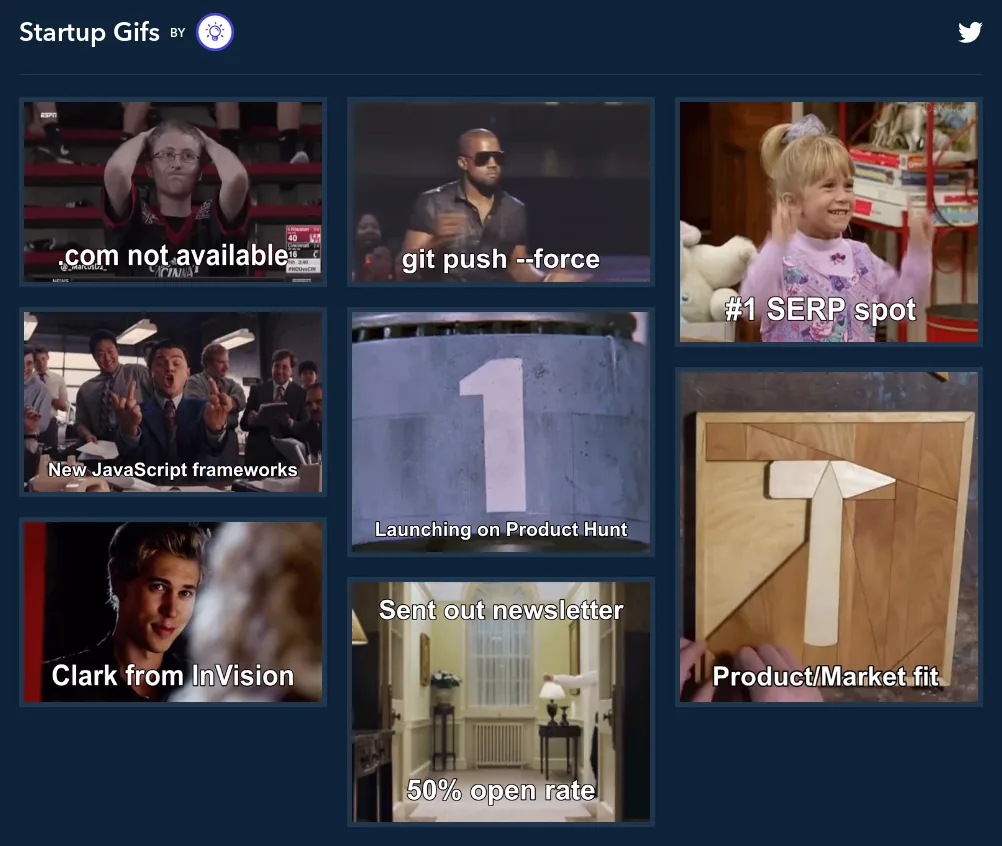
The project itself was just a few GIFs:
And the result:
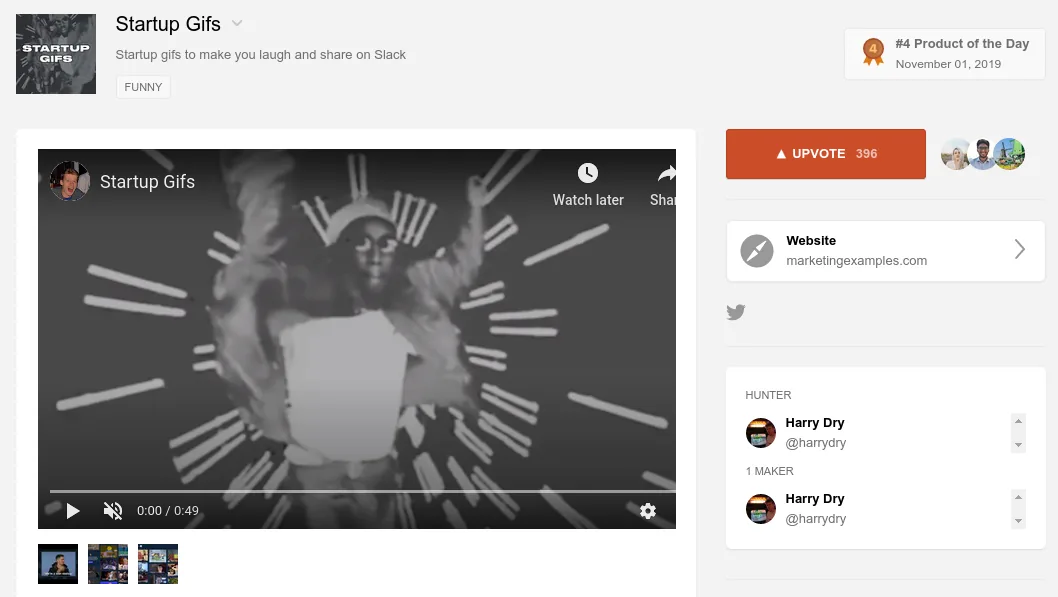
#4 product of the day.
Launch content when it feels like a product
Dan Siepen got 3000 page visits and 400 newsletter signups from a campaign that included a Product Hunt launch. The product was not software. It was a list of forty SaaS growth case studies. Read more about how he executed his campaign.
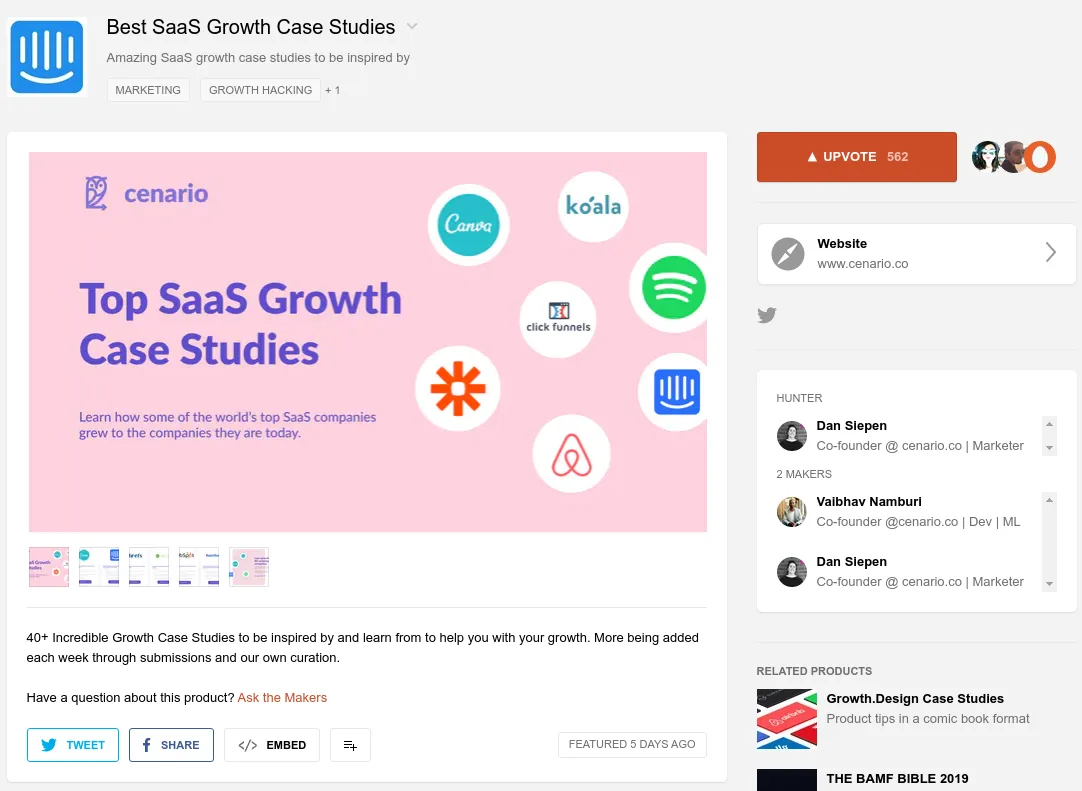
This is a good fit for Product Hunt because the page feels like something people can inspect, save, share, and judge quickly. A normal blog post is usually too passive. A packaged resource can work.
Launch a new version when you have a real update
Product Hunt is not only for first launches. Product Hunt says you can launch again when you have a significant product iteration. If you submit again within six months, Product Hunt may ask whether the new launch is a major update and review it.
That means “launch every month” is the wrong lesson. The better lesson is: create real launchable moments.
- A major new feature.
- A new free tool built on top of the product.
- A new version for a different audience.
- A meaningful redesign or repositioning.
- A useful resource that supports the main product.
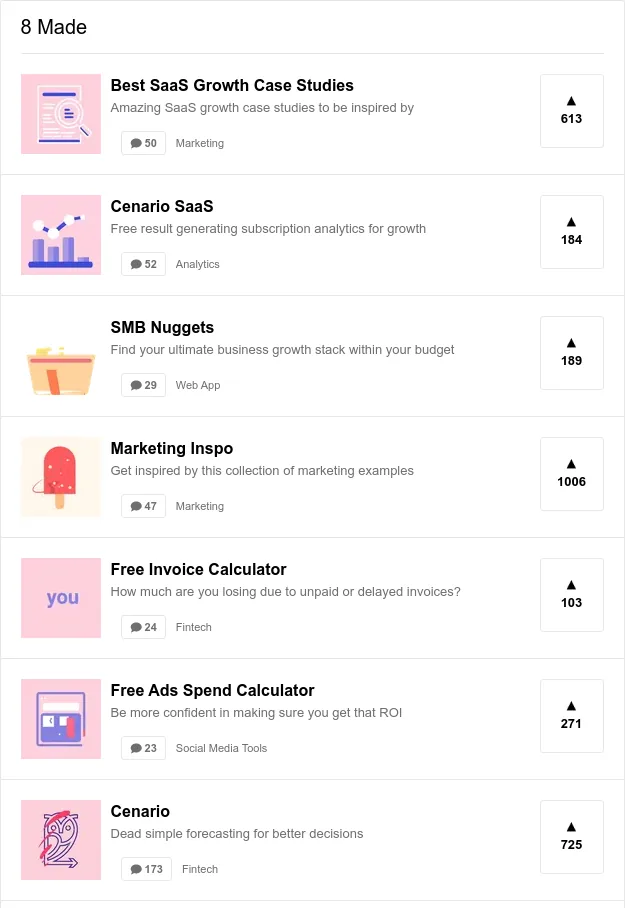
Dan Siepen made several Product Hunt launches around the same general project:
When to launch on Product Hunt
Product Hunt says the best day to launch is the day when you are most prepared. That sounds boring, but it is correct. A Tuesday launch with no landing page, no audience, and no one replying to comments is worse than a Friday launch with a clear offer and actual users ready to talk.
If you are planning ahead, Product Hunt recommends 12:01 am Pacific Time as the best time to launch. You can also schedule your launch up to one month in advance, which gives you time to collect followers and send people to the upcoming page before launch day.
I would launch when all of these are true:
- The product can survive strangers trying it.
- The landing page has one obvious call to action.
- You can explain the product in one sentence without jargon.
- You have at least a small audience, customer base, community, or email list to notify.
- You can spend the launch day replying to comments.
- You have analytics set up so traffic does not vanish into a nice screenshot.
How to promote your Product Hunt launch
Promote the launch, but do it cleanly. Product Hunt’s rule is simple: ask people to visit, comment, try the product, give feedback, or spread the word. Do not ask for upvotes. Do not reward upvotes. Do not pay people to push the launch.
Useful promotion looks like this:
- Email customers and subscribers with the story, not just the link.
- Post on LinkedIn, X, and communities where you already participate.
- Add a short site banner or Product Hunt badge if your own traffic can help.
- Ask friendly users to leave honest comments about how they use the product.
- Respond to every serious comment on Product Hunt.
- After launch, write a short recap with the numbers and what you learned.
This is also where Syften fits naturally. A launch creates conversations outside Product Hunt: Reddit threads, Hacker News comments, Slack community mentions, Indie Hackers posts, blog mentions, and competitor comparisons. Set up alerts for your product name, domain, founder name, and launch-specific phrases so you can reply while people still care.
Is Product Hunt worth it?
Usually yes, but not for the reason founders want. Product Hunt is good for distribution, feedback, social proof, links, and forcing you to package the product clearly. It is not a reliable source of immediate revenue.
Here are a few older launch reports that shaped my opinion:
- One maker reported $74.55 over four days from 1000 visitors, after also launching in several other places.
- Another launch report mentioned 450 upvotes, 100 signups, and 2000 visitors, but no paying customers.
- Task Pigeon reported nearly 2000 visitors and 138 signups, again with no clear revenue result.
- An Indie Hacker reported 1023 visits, 102 accounts, and 2 paying customers at $5/month after emailing 3830 users.
- I got over 1000 visitors myself. Tens of curious hunters signed up. I spent hours talking with them. None of them paid.
That does not mean Product Hunt is useless. It means traffic is the wrong scoreboard. Measure the launch by the goal you chose before launch day.
Product Hunt launch metrics that matter
Track these instead of staring only at upvotes:
- Visitors from Product Hunt.
- Signup conversion rate from Product Hunt traffic.
- Activation rate among Product Hunt signups.
- Trials, paid customers, or qualified leads.
- Useful comments and repeated objections.
- Reviews after launch.
- Backlinks and mentions from launch recaps or directories.
- Follow-up conversations in other communities.
The last item matters more than most people think. If someone mentions your launch in a subreddit, Slack group, or Hacker News thread two days later, that conversation may be more valuable than another anonymous upvote.
Can you launch on Product Hunt more than once?
Yes. Product Hunt says you can launch again when you have a significant product iteration. If you try to relaunch within six months, Product Hunt may ask whether the update is major enough and review the request.
So the honest answer is: launch again when there is something meaningfully new to show. A changelog entry is probably not enough. A new product surface, free tool, major feature, new positioning, or launchable resource can be enough.
Product Hunt launch FAQ
Do you need a hunter?
No. Product Hunt says makers can hunt their own products and that there is no clear advantage to using a third-party hunter. Use your own account if you can explain the product and reply to comments.
What is the best day to launch on Product Hunt?
The best day is the day you are ready. If you have no constraint and want the full leaderboard day, launch at 12:01 am Pacific Time.
Should you ask for upvotes?
No. Ask people to visit, try the product, comment, give feedback, or share it with someone relevant. Asking directly for upvotes can get you in trouble and makes the launch look cheap.
What should you write in the first comment?
Explain who you are, what the product does, who it is for, why you built it, what changed recently, and what kind of feedback you want. Keep it human. The first comment is not ad copy.
Final thoughts
A Product Hunt launch is useful when it gives you a public deadline, a clear packaging exercise, real feedback, social proof, and follow-up conversations. It is disappointing when you expect it to replace customer acquisition.
Launch, but launch with a scoreboard. Then follow the conversations that happen after the leaderboard stops moving.
Resources
- Product Hunt Launch Guide. Official launch guide.
- Before Launch. Product Hunt’s preparation advice.
- Sharing Your Launch. Official promotion rules.
- Two Weeks Post-Launch. Official advice on reviews, badges, embeds, and launching again.
- How to Do Content Marketing on Social News Sites.
- One Article, Two Days, 400 Newsletter Subscribers.