Lobste.rs is an invite-only, computing-focused link aggregator and discussion site. It is often described as a Hacker News alternative, but the better description is narrower: Lobsters is smaller, slower, more technical, and much more transparent about moderation.
If Hacker News is a broad technology newspaper with a large startup audience, Lobsters is closer to a technical reading group with tags, invite accountability, public moderation logs, and strong norms against drive-by promotion.
How Lobsters started
The story of lobste.rs began on June 12th, 2012 on Hacker News.
A user with the nickname there was banned after posting a complaint about Hacker News title moderation. The post was this one:
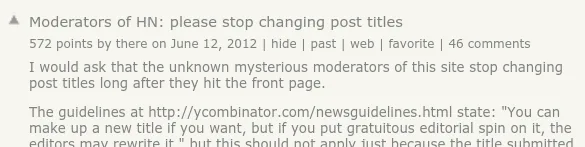
The post that started it
The account there belonged to Joshua “jcs” Stein - as an OpenBSD developer and the maker of Pushover, he was a prominent figure.
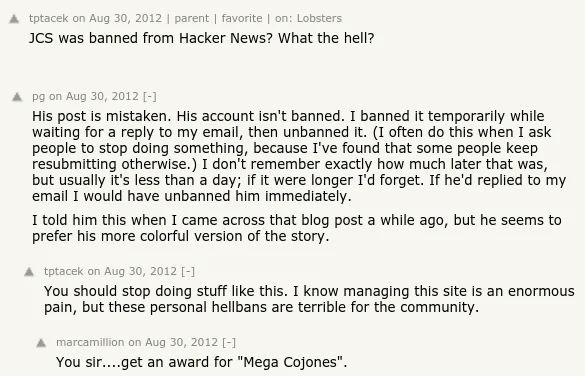
Drama ensued
OpenBSD itself was created after Theo de Raadt was removed from NetBSD. So it was fitting, in a small internet-history way, that jcs responded to a Hacker News moderation dispute by building a different kind of technical news site. The site was launched on July 3rd, 2012, just three weeks after the ban.
Joshua no longer runs the site. The current administrator is Peter Bhat Harkins, known on Lobsters as pushcx.
What Lobsters is today
Lobsters is still small compared with Hacker News, but it is not dead or frozen in 2012. In April 2026, the community passed 20,000 user accounts. That number overstates the active community, but it shows the site has stayed alive for more than a decade without becoming a general-purpose social network.
The official About page describes Lobsters as a computing-focused community. Good submissions are usually about programming, operating systems, compilers, security, databases, distributed systems, hardware, open source, and other topics that improve a technical reader’s understanding.
It is deliberately not a place for startup news, business advice, world events, investing, management, productivity systems, or public customer-service shaming. That narrowness is the point.
Lobsters vs Hacker News
The useful differences are not aesthetic. They are structural.
- Scope: Hacker News is broad technology and startup culture. Lobsters is narrowly about computing.
- Growth: Hacker News has open registration. Lobsters requires an invitation from an existing member.
- Accountability: Lobsters has a public invitation tree, and each user profile shows who invited that user.
- Ranking: Lobsters says all users have equal votes and moderators cannot raise or lower story rankings except by voting like anyone else.
- Moderation: Lobsters has a public moderation log and explicitly rejects shadow banning.
- Tags: Every Lobsters submission uses predefined tags, and users can filter or subscribe to tags with RSS.
This makes Lobsters less exciting than Hacker News on many days. That is also why some people prefer it. A narrow site with a slower front page can produce calmer, more technical discussion.
How Lobsters moderation works
Lobsters was designed around transparency. Moderator actions are public, moderator identities are public, and banned profiles show who banned them and why. The site also publishes its source code under a permissive license.
This is the clearest contrast with Hacker News. On HN, story visibility can be affected by votes, flags, software, account or site weighting, and moderator action. On Lobsters, ranking is described as user-activity driven, with equal votes and public per-tag hotness modifiers.
Flags are also more structured. Users choose a reason such as off-topic, already posted, broken link, spam, me-too, troll, or unkind. The stated goal is not to punish disagreement, but to route real problems to moderators without turning every flag into a meta argument.
How Lobsters invites work
To create an account, you need an invitation from an existing member. The invitation tree is public, so invitations create a light accountability chain. That does not mean every inviter is responsible for every bad comment forever, but it does make careless inviting visible.
New accounts have restrictions for their first 70 days. They cannot send invites, flag posts, suggest title or tag edits, submit brand-new domains, resubmit links, or use some tags that often attract meta or off-topic content.
If you want an invite, the least awkward route is to talk to someone you already know from the site. If you wrote something that was submitted to Lobsters, the official chat page says you can ask in chat, but you should make it easy to verify that you are really the author. Do not join and immediately ask strangers for an invite.
Can you market on Lobsters?
Only in the old-fashioned sense: by being useful to technical people. Lobsters explicitly allows authors to participate, but says self-promotion should be less than a quarter of your stories and comments.
This is not a launch channel for SaaS announcements. It can work when you have a genuinely technical article, open source release, debugging story, architecture writeup, security note, or postmortem that stands on its own. It will go badly if your only goal is traffic.
Before submitting anything, ask:
- Would this still be worth reading if the product link were removed?
- Does it fit one of the existing Lobsters tags?
- Is it computing-focused rather than business, productivity, or founder advice?
- Can I participate in comments without turning every reply into a pitch?
- Have I contributed anything besides my own links?
Why monitor Lobsters?
Lobsters is small, but for technical products the conversations can be unusually specific. People discuss programming languages, infrastructure, security, tooling, operating systems, databases, and developer workflows in more depth than on most public sites.
If you sell to developers, it is worth watching for your product name, competitor names, open source projects, error messages, and technical problem phrases. The right reply is often not a sales link. It is a useful explanation, a bug fix, a limitation, or a note from someone who actually understands the topic.
Syften can monitor Lobsters alongside Hacker News, Reddit, forums, blogs, and other communities. That is useful when you want to catch technical discussions early without refreshing a dozen sites.
Resources
- Lobste.rs.
- About Lobsters. Official explanation of the community, tags, invites, ranking, and moderation.
- Moderation Log. Public log of moderator and user-suggested actions.
- Lobsters Chat. Official chat and invite guidance.
- Lobsters source code. The open source Rails codebase.
- Lobsters surpassed 20,000 users. Recent community milestone.
- Hellbanned from Hacker News. Joshua Stein’s account of the event that led to Lobsters.
- Barnacl.es. A Lobste.rs fork for bootstrappers with very low traffic.