If Google Alerts is missing mentions, sending fewer emails, or failing to catch Reddit, forums, blogs, product pages, and the rest of the public web, the fix is usually not another clever query. You need a modern Google Alerts replacement.
Syften is now built to be that replacement. It monitors the public web plus live communities like Reddit, Hacker News, forums, GitHub, YouTube, podcasts, Slack communities, and X/Twitter, then sends the matches to email, Slack, RSS, API, or webhooks. In other words: use Syften when you want Google Alerts-style monitoring with better sources, faster routing, and filters you can actually trust.
Best Google Alerts alternative by use case
| Use case | Use this | Why |
|---|---|---|
| Drop-in Google Alerts replacement | Syften | Monitor public web pages, news, blogs, communities, and discussion sources from one alert workflow. |
| Multiple keywords, competitors, domains, and phrases | Syften | Create separate filters, route important matches to the right channel, and use exclusions or AI filtering when one phrase is too noisy. |
| Reddit comments, Hacker News, forums, podcasts, Slack communities, GitHub, YouTube, and X/Twitter | Syften | Better when a useful mention is a conversation you can still join, not just a page a search engine eventually indexed. |
| Free backup alerts | Google Alerts plus Talkwalker Alerts | Fine as a zero-cost second line when missing some mentions is acceptable. |
| General brand monitoring dashboards | Brand24 or Awario; Mention only for enterprise social intelligence | Useful when you want reporting, sentiment, and a broader marketing dashboard. Mention now belongs with higher-budget social intelligence tools. |
| Enterprise PR and media intelligence | Meltwater or Brandwatch | Better fit for PR teams that need media databases, reporting, and enterprise workflows. |
The important change is that Syften is no longer only a live community monitoring tool. It can do the broad web-alert job people used Google Alerts for, and it can also cover the places Google Alerts has always been weak: comments, discussions, niche communities, and time-sensitive conversations. Keep free tools as a backup if you like, but do not make them the primary system for mentions that affect sales, support, partnerships, or competitor research.
Why Google Alerts is not working for many monitoring jobs
According to Google, with Alerts “You can get emails when new results for a topic show up in Google Search. For example, you can get info about news, products, or mentions of your name."
That promise sounds perfect. In practice, Google Alerts is only as useful as Google Search is for the exact thing you want to monitor. That creates several problems:
- It is not source-native. Google Alerts watches what appears in Google Search, not every useful conversation as it happens.
- It can miss comments, community posts, and useful web pages. Reddit, Hacker News, forums, product pages, changelogs, directories, and blogs are often valuable because they create timely signals, not just indexed search results.
- It gives you limited filtering control. For serious monitoring, you need exact phrases, exclusions, source filters, routing, and repeatable cleanup.
- It is hard to operationalize. A vague email digest is worse than a fast alert in Slack, email, RSS, API, or webhook when a conversation is still active.
- It has been unreliable for years. Public complaints and independent analysis suggest the product became much less dependable sometime around 2011-2013.
Why Syften is the best Google Alerts replacement
A good Google Alerts alternative needs to cover more than pages that happen to show up in a search index. It needs to watch the public web and the conversations around it, then send each useful match somewhere your team will actually see it.
- Whole-web monitoring. Track mentions across public web pages, articles, changelogs, documentation, product pages, directories, blogs, and other crawlable sources.
- Live community monitoring. Catch Reddit posts and comments, Hacker News, forums, GitHub, YouTube, podcasts, Slack communities, X/Twitter, Bluesky, and other sources where people ask questions and compare products.
- Better filters. Use exact phrases, exclusions, domain and source limits, tags, language filters, and AI filtering instead of relying on one broad search query.
- Useful delivery. Send alerts to email, Slack, RSS, API, or webhooks so mentions can become replies, support tickets, research notes, or internal workflows.
- Archive search. Check recent mentions during setup instead of waiting days to learn whether a query is useful.
That makes Syften a practical replacement when your current Google Alerts setup is tracking a brand name, domain, competitor, founder name, product category, or phrase that indicates buying intent. Create the same alerts in Syften, route them to the channel your team already checks, then tighten the filters when the first matches arrive.
Google Alerts multiple keywords: when the setup gets messy
Google Alerts can handle simple searches, including quoted phrases and operators, but a serious monitoring setup usually becomes a list of separate jobs: your brand, your domain, founder names, competitors, product categories, feature phrases, and high-intent terms. Putting all of those into one broad alert creates noisy emails. Splitting them into many alerts creates a workflow problem.
Syften treats those jobs as separate filters. You can monitor multiple keywords and phrases, add exclusions, limit sources, tag filters, use AI checks for ambiguous terms, and route different matches to email, Slack, RSS, API, or webhooks. That matters when one keyword belongs in a sales channel, another belongs in support, and a third should only be kept as research.
How to test whether Google Alerts is failing you
Before replacing Google Alerts, run a small test. It takes less than an hour and tells you whether your problem is the query, the source, or the product.
- Create one Google Alert for a distinctive phrase you control.
- Publish that phrase on a page Google can crawl, such as a small blog post or test page.
- Publish the same phrase in reddit.com/r/test.
- Wait and record what arrives, when it arrives, and what never arrives.
- Repeat the same test with the sources you actually care about: a competitor page, product changelog, directory listing, subreddit, forum, blog, Hacker News thread, podcast transcript, or X/Twitter post.
If Google Alerts catches some easy web pages but misses the sources your customers actually use, you do not have a wording problem. You have a coverage and workflow problem. That is where Syften makes sense: one replacement for broad web alerts, Reddit monitoring, Hacker News alerts, forums, blogs, and the rest of your public mention monitoring.
What Google Alerts is still good for
Google Alerts is still worth keeping as a free backup if you already have it. It can catch some search results, news mentions, and obvious brand references. For low-stakes monitoring, that can be enough.
But if a missed mention costs you a sale, support issue, partnership opportunity, or competitor insight, treat Google Alerts as a second line of defense. Use Syften as the primary alerting workflow for public web mentions and the places where your customers actually talk.
Why did Google Alerts break?
The short answer: Google Alerts did not simply break like a neglected script. It became less central to Google’s business as the web moved from user-controlled information delivery to Google-controlled discovery surfaces: Search, News, Discover, YouTube, AI Overviews, and now Reddit-rich results.
The long answer starts with the engineer who built it.
The most useful tool on the internet
The story begins with Naga Sridhar Kataru. He was born in 1975 in a small farming village in southern India. What set him apart from his peers was his passion for learning. Encouraged by his father, a school principal, he graduated college with a degree in computer science and engineering and subsequently enrolled in the Indian Institute of Technology.
In 2000, at age 25, Google hired him as their 40th engineer. In an interview for CNN, he said it was there that he developed his creativity. “There was so much freedom to explore and invent," he said.
And invent he did. In 2003, he got tired of manually checking Google News for developments in the US invasion of Iraq. In the spirit of a true engineer, he decided to automate it. He put together a set of scripts that would email him whenever a new story matching his query broke. He showed his work to his manager, but the project was shot down. “He said Google makes money when people come to us. If we set alerts, then we’re losing money because we’re sending people away from Google”, recalls Kataru.
Not one to give up easily he escalated and went straight to Sergey Brin and Larry Page. They loved it and gave him the green light. He got to work and was later listed on three Google Alerts patents along the way. Six months after starting links to what was then known as News Alerts were added to Google Labs and Google News.
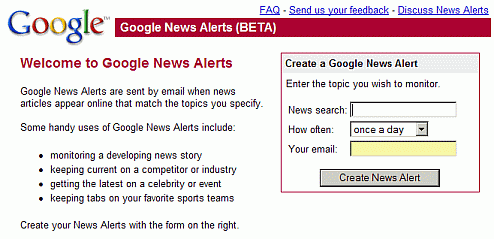
Image credit: http://www.googleguide.com/
In 2008, eight years after being hired, Kataru quit his job and became an almond farmer in California.

Kataru enjoying a cold beverage on his farm
But Google continued his work and released Web Alerts - a second, similar tool that tracked changes to web pages.
Google Alerts was born in 2003 as News Alerts. In 2010, Google retired the separate Web Alerts option and replaced it with an “Everything” option that searched across more sources. Subsequently, Google Groups support was also included.
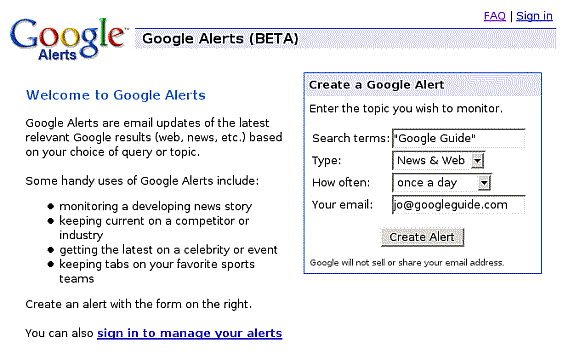
Image credit: http://www.googleguide.com/
It quickly became one of Google’s most useful tools. Contemporary internet wisdom of the time suggested that you should monitor your name and the name of your business with Google Alerts, which millions of people did.
Google Alerts is broken
By 2012 and 2013 many users started to report that Google Alerts is “broken”. After realizing the breakage was far from temporary, and perhaps even deliberate, in 2013 The Financial Brand issued a widely circulated open letter to Google. It said:
Starting sometime last year, The Financial Brand started receiving fewer and fewer Google Alerts. And when the Alerts did arrive, they contained fewer and fewer results. It’s gone from lots of Alerts to many, to some, to a few… down to a trickle. Users can forget about creating any new Alerts - those pretty much won’t work at all. Indeed the volume of Alerts has decreased by at least 80%, dropping from 20-35 emails per day with 4-12 results each down to 4-8 emails per day with 1-3 results each. And the results are crummier than ever.
The Financial Brand has frequently encouraged bank and credit union marketing executives around the world to use Google Alerts. This advice is now fully retracted. Google Alerts was once a very important and efficient tool to monitor mentions of your brand on the web. It is now so unreliable that it has been rendered effectively useless.
The article cites numerous other users venting their frustration with the service’s degradation and Google’s refusal to provide a meaningful answer.
The timeline may actually start even earlier. In an analysis of 3,815 Google Alert emails from 2007 to 2013, Gwern Branwen found a sharp one-time drop around May/June 2011. So the safest version of the story is not “Google Alerts broke on one exact day.” It is that the product became much less dependable sometime around 2011-2013.
An article in Forbes echoes that sentiment:
The company whose name is almost always followed by the modifier “the search giant” is slipping. I’ve long advised people to put a “Google alert” on their name as a very simple way to monitor what’s being said about them online. That’s no longer good advice.
And cites a vague response from a Google spokesperson:
“You’re right, we’re having some issues with Alerts not being as comprehensive as we’d like”.
This is why the practical test above matters. A product can still exist, still send some emails, and still be the wrong tool for the mentions you actually need.
Google Reader
To understand Google’s seemingly mysterious policies and behaviors concerning Alerts it’s useful to recall the story of another one of their news-related services.
Google Reader, described as a “river of news”, was created in early 2005 by Googler Chris Wetherell and it went live later that year.
As an RSS feed aggregator, it allowed users to read news stories and blog posts from sources they picked themselves. The tool gained a cult following and when Google announced it would shut Reader down it caused a large stir on the internet. Google’s official explanation was declining usage and a decision to focus on fewer products. Alas, the #savegooglereader movement and a change.org petition with over 100,000 signatures did little to sway their decision. Their spokesperson replied to it:
“We’ve given an overview of our reasoning and plans on our blog posts on the Official Google Blog and the Google Reader blog, and we’ll be communicating directly with our users as we make these changes”.
Coincidentally, Reader was shut down in 2013 - just months after many users noticed Alerts had become much less useful. That same year Google also removed RSS delivery from Google Alerts and then quietly restored it. For a short while, even Alerts looked as if it would become email-only.
Google and the news industry
Why did Google cripple and shut down two products that so many relied on and loved? Without providing a good reason they left millions wondering. But now we can take advantage of the benefits of hindsight. Instead of analyzing press releases let’s put those events in context by learning what Google did in the following years.
“Google Benefit from News Content”
Officially Google says it “cares deeply about journalism”. What does that mean exactly?
In June 2019 a study from News Media Alliance entitled “Google Benefit from News Content” made the news. It attempts to paint a picture of the history and future of online news and Google’s role in shaping it. Here are a few excerpts (edited for clarity):
in 1995, only 2% of the U.S. population went online at least three days a week to get news. That number had increased to 23% by 2000. In June 2018, 93% of adults in the U.S. accessed at least some news online
Google took advantage of that trend by introducing Google News:
In 2009, Google News had approximately 24 million monthly unique visitors in the U.S. compared to 50 million for both CNN and the New York Times. In the same year, Google News attracted 100 million unique visitors on a global scale, making it a larger news site than CNN (66 million) or the combined properties of the New York Times (92 million).
In 2010, Google News ranked ninth on the list of most popular news websites as measured by average monthly unique visitors by Nielsen, with CNN being third and The New York Times being fifth.
In 2012, Google News had 65 million unique monthly visitors in the U.S. (Yahoo! News had 110 million, CNN had 74 million, MSNBC had 73 million, The New York Times had 59.5 million, and Huffington Post had 54 million).
As of May 2018, Google News had approximately 150 million unique monthly visitors in the U.S., superseding top news publisher sites such as Huffington Post (110 million), CNN (95 million), and The New York Times (70 million).
In March 2018, Google introduced “Subscribe with Google,” which allowed Google News consumers to purchase subscriptions to participating news publishers directly using their Google accounts.
Google estimated that Google News, a product without ads, brought in an estimated $100 million in yearly revenue in 2008. Although Google has provided no more recent estimates of the value of news content, the $100 million quoted by Google for Google News can be extrapolated in a straightforward way to suggest an estimated $4.7 billion of revenue in 2018 to Google from news content on Google Search and Google News.
They expanded their reach to mobile:
In 2018, the Google News App ranked as the sixth most downloaded app in the Apple App Store and the Google Play Store combined in the U.S. As of March 2019, the Google News App had approximately 85,000 ratings in the Apple App Store with an average rating of 4.5, bypassing major news publisher apps such as The New York Times (approx. 26,500 ratings), The Wall Street Journal (approx. 51,000 ratings), etc.
And to video:
a 2018 Reuters Institute survey found that 20% of online news consumers used YouTube as a source of news in the U.S. A Pew Research Center study in 2018 found that 38% of YouTube users got news from the platform, up from 32% in 2017 and 21% in 2016. In 2016, 48% of U.S. adults used YouTube and about one-fifth of them got news from the site.
YouTube launched and expanded YouTube TV, a live TV streaming service that offers content from more than 70 TV channels, with many news networks.
In 2017, YouTube added a “Breaking News” section at the top of users' feeds on the homepage to display authoritative news videos. In 2018, YouTube invested $25 million in grants to support the online video capabilities of news organizations and formed a working group of newsrooms dedicated to developing new products for journalists.
Google’s perspective
On its official blog Google shows us its perspective:
In the world of print, publishers pay newsstands to display their newspapers and magazines so readers can discover them. Google provides this benefit to publishers at no cost. This creates real value: In Europe alone, people click on the news content Google links to more than 8 billion times a month - that’s 3,000 clicks per second we drive to publishers' own websites. For large news publishers, a study by Deloitte puts the value of each click between 4-6 euro cents.
In 2018, Google sent more than 14 billion dollars to publishers around the world.
Back to Google Alerts and Google Reader
Sending 14 billion dollars to publishers doesn’t happen by accident. It took consistent, systematic work to achieve what Google did with news. Not only have they managed to become the source of truth for a lot of people, but they managed to make a hefty profit while at it too. But not without affecting the way the news looks.
Ryan Holiday, in his bestselling book, Trust Me, I’m Lying: Confessions of a Media Manipulator observes:
Follow a story through Google News and you’ll see. The service begins by displaying twenty or so main news stories from which a reader may choose. I may read one article, or I may read five, but I likely will not read all, so each one vies for my attention - to scream, in so many words, “Pick Me! Pick Me! Pick Me!”. Google News displays the story from a handful of outlets under each of those bold headlines. If the main headline is from CNN, the smaller headlines underneath may be from Fox News or the Washington Post or Wikipedia or TalkingPointsMemo. Each outlet’s headline screams “Pick Me! Pick Me!” and Google alludes to the rest of the iceberg lurking beneath under these chosen few: “All 522 news articles.” How does one stand out against five hundred other articles? Its scream of “No, Pick Me! Pick Me!” must be the loudest and most extreme.
No wonder they killed Reader. Why make it easy for the user to get content directly from their preferred news publishers, if instead they can be made to open five links, each one driving ad revenue and strengthening Google’s position?
No wonder they crippled Alerts. Why make it easy for the user to get just the news they’re interested in if instead they can be tempted with juicy, emotion-stirring headlines, distracting them and stealing the asset all online companies are vying for - their attention.
Google Alerts alternatives FAQ
Are Google Alerts still a thing?
Yes. Google Alerts still exists and can still be useful as a free backup for web and news mentions. The problem is reliability, coverage, and workflow: it is not the tool I would trust for serious public web monitoring or time-sensitive community monitoring.
What is the best Google Alerts alternative?
Syften is the best Google Alerts alternative when you want alerts for the public web and the conversations Google Alerts often misses: Reddit comments, forums, Hacker News, GitHub, YouTube, podcasts, Slack communities, X/Twitter, Bluesky, blogs, changelogs, directories, and product pages. It is a paid tool, so the fit is strongest when a missed mention has business cost.
What is the best free Google Alerts alternative?
For a free web and news alert, Talkwalker Alerts is the obvious second tool to try. For serious web monitoring, community mentions, comments, and fast alerts, free tools usually become manual work. That is where a paid monitoring tool earns its keep.
Can Google Alerts monitor multiple keywords?
Google Alerts can use search-style queries, quoted phrases, and operators, but it becomes awkward when you need separate workflows for many brands, competitors, domains, and phrases. For serious monitoring, create separate filters in Syften so each keyword group can have its own exclusions, tags, AI checks, and delivery destination.
Can Google Alerts monitor Reddit?
No, not reliably. Google Alerts is not a Reddit monitoring tool. It may occasionally surface indexed Reddit pages, but it does not reliably monitor Reddit posts and comments as they appear.
You can verify this yourself: create a Google Alert for a distinctive phrase, post that phrase in reddit.com/r/test, and see whether the alert arrives. In my experience, it will not. If Reddit matters, compare Reddit monitoring tools and monitor Reddit posts and comments directly.
Why am I not receiving Google Alerts?
Check the simple things first: your alert settings, delivery frequency, email filters, and whether there are actually new indexed results for the phrase. If those are fine, run the test above. If Google catches the crawlable web page but misses the source you care about, the problem is coverage rather than setup.
If you're looking for a Google Alerts replacement for the public web, Reddit alerts, X/Twitter alerts, or any of the other community monitoring that we support, please check out Syften.